Technology is no longer evolving quietly in the background.
It’s reshaping how people work, communicate, shop, learn, travel, and even think — faster than most users can keep up with.
Just a few years ago, artificial intelligence felt experimental. Mixed reality looked like expensive sci-fi. Quantum computing sounded like something only researchers cared about.
Now?
AI writes emails inside your browser. Smart glasses are replacing screens. Devices are becoming proactive instead of reactive. And scientists are building systems that could completely redefine medicine, security, and human-computer interaction.
The biggest shift in 2026 isn’t just “more technology.”
It’s that technology is becoming:
- more personal
- more autonomous
- more immersive
- and increasingly invisible
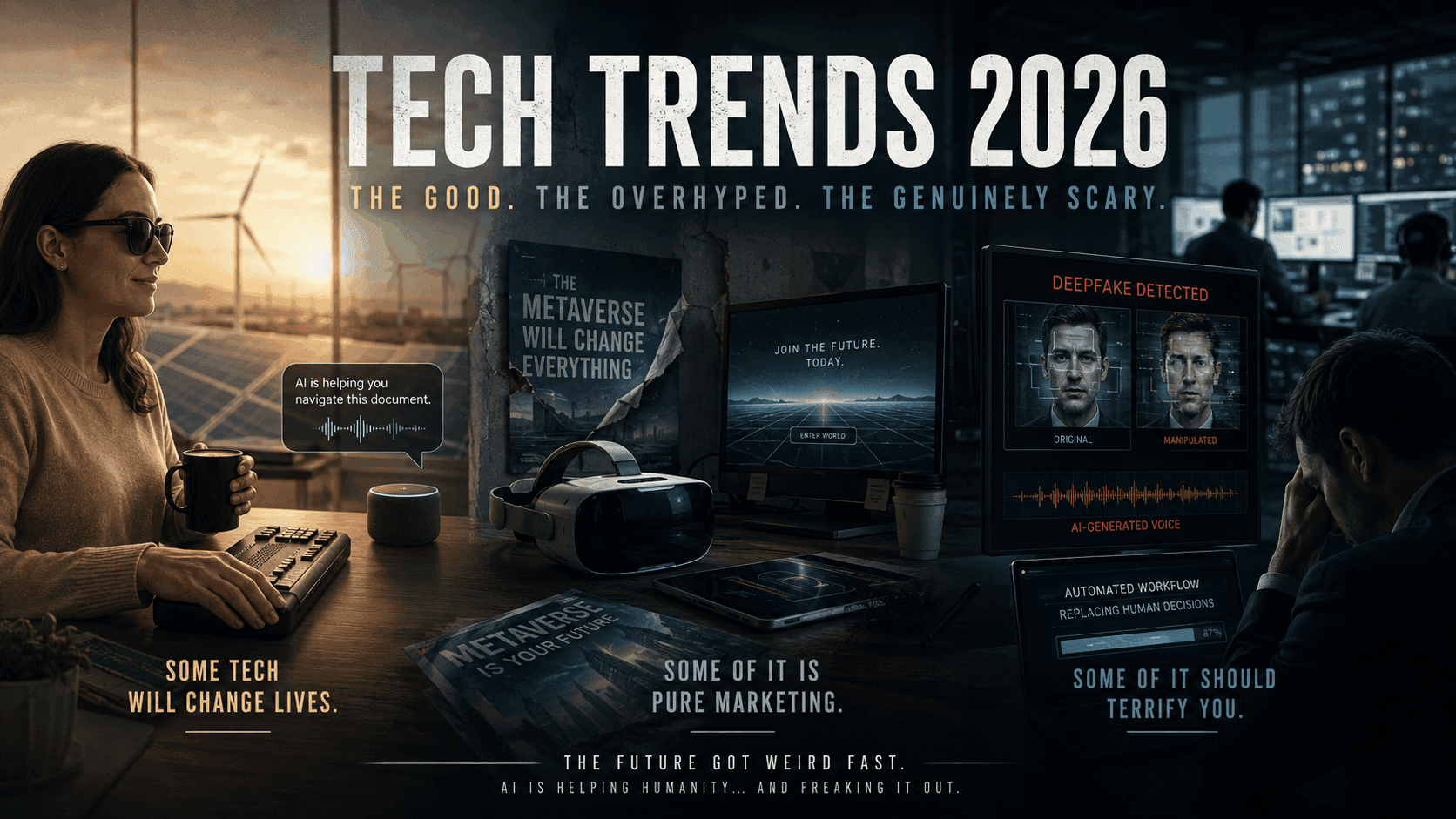
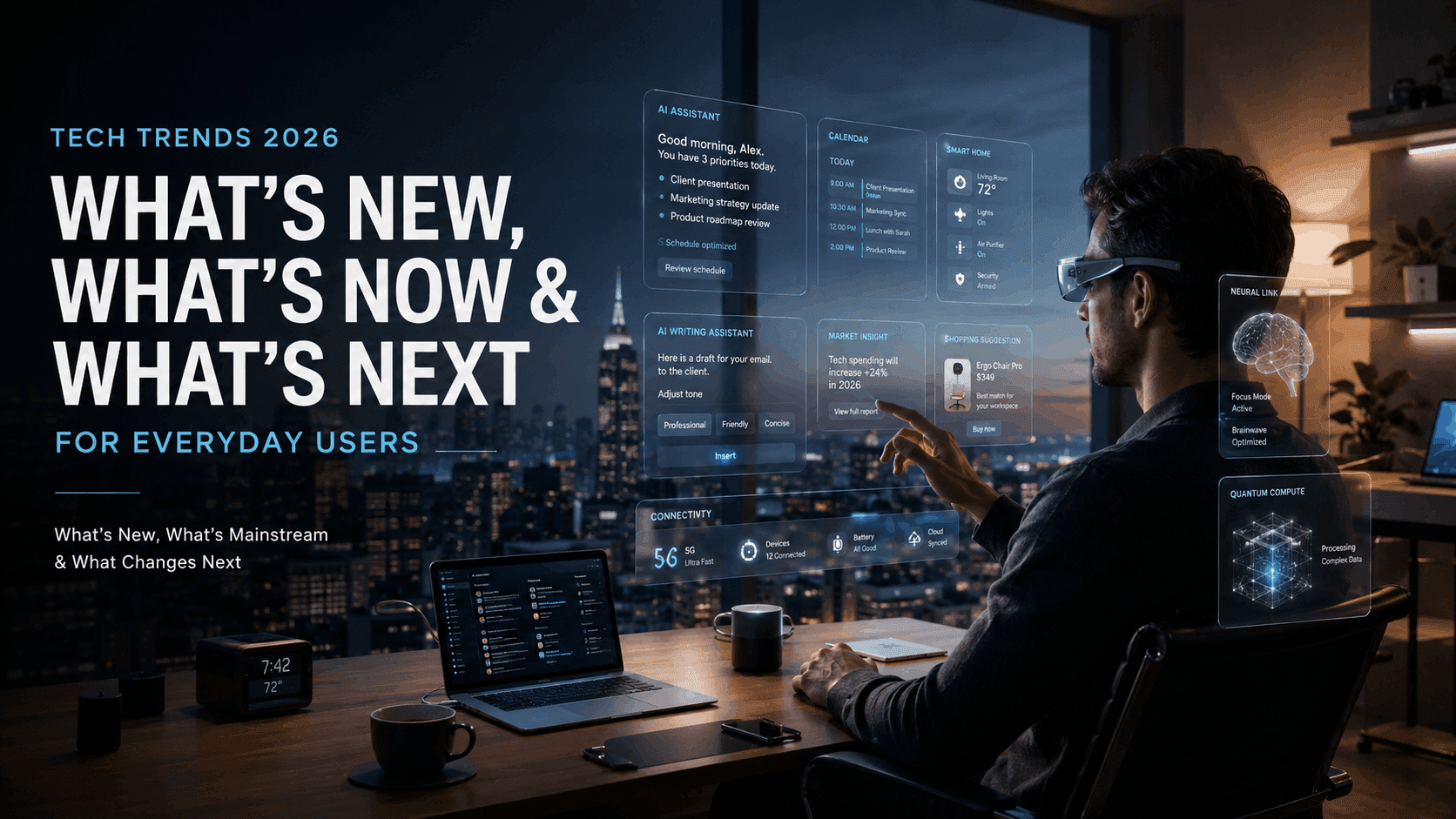
This guide breaks down the most important tech trends shaping 2026 — from what’s already changing daily life to what could completely transform the next decade.
What's New: Emerging Tech Trends Going Mainstream
These technologies are moving beyond hype and starting to enter everyday consumer life.
1. Spatial Computing Is Escaping the “Early Adopter” Phase

For years, virtual reality felt isolated and niche.
But spatial computing is changing the conversation completely.
Instead of trapping users inside virtual worlds, spatial computing blends digital content directly into physical space. Apps, screens, notifications, and workspaces can now appear around you naturally.
Devices inspired by products like Apple Vision Pro are pushing the industry toward:
- mixed reality glasses
- wearable computing
- immersive productivity
- screen-less digital environments
In 2026, the biggest shift is portability.
The first wave of headsets felt bulky and expensive. Newer generations are becoming:
- lighter
- more socially acceptable
- more productivity-focused
- better integrated with everyday life
What This Means for Everyday Users
Instead of sitting behind a laptop all day, users may:
- open floating virtual monitors
- watch movies on giant digital screens anywhere
- collaborate in immersive workspaces
- navigate cities using augmented overlays
- interact with digital objects naturally
Spatial computing is gradually turning physical space itself into an interface.
Why It Matters
This could become the biggest interface shift since smartphones.
The long-term goal isn’t just replacing monitors.
It’s replacing the concept of “screens” entirely.
2. AI Agents Are Starting to Work For You

Most people already use AI for:
- writing
- brainstorming
- summarizing
- searching
But the next wave is far more powerful.
AI agents are evolving from “tools you use” into systems that actively complete tasks on your behalf.
Instead of asking AI to help write an email, users are beginning to ask AI to:
- schedule meetings
- compare products
- book travel
- manage calendars
- organize tasks
- handle repetitive workflows
The difference is autonomy.
Modern AI systems increasingly understand:
- context
- goals
- priorities
- multi-step tasks
Real-World Examples Emerging in 2026
AI assistants are beginning to:
- rebook flights automatically
- optimize schedules
- summarize entire inboxes
- purchase recurring household items
- coordinate smart home devices
- manage customer support conversations
This is creating a shift from “searching for information” to “delegating actions.”
The Big Concern
Convenience comes with major questions:
- How much control should AI have?
- What data should AI access?
- Can autonomous systems be trusted financially?
- What happens when AI makes mistakes?
The future of AI agents will depend heavily on trust, transparency, and security.
What's Now: Tech Trends Already Changing Daily Life
Some trends already became part of everyday technology — even if many people barely notice it.
3. Generative AI Is Being Embedded Into Everything

AI is no longer a separate app.
It’s becoming a built-in layer across almost every major platform.
In 2026, generative AI features are integrated into:
- document editors
- spreadsheets
- browsers
- smartphones
- search engines
- email platforms
- design software
- productivity tools
Platforms like:
- Microsoft Copilot
- Google Gemini
- Notion AI
- ChatGPT
are transforming how users interact with software daily.
What Everyday Users Are Experiencing
AI now helps users:
- draft emails
- summarize meetings
- generate formulas
- rewrite documents
- analyze spreadsheets
- create presentations
- organize notes
- answer questions instantly
The result is a huge productivity shift.
Software is becoming collaborative instead of passive.
The Hidden Change
Users are slowly moving away from:
- menus
- manual workflows
- complex software navigation
Instead, people increasingly interact with apps conversationally.
Typing instructions is replacing traditional software learning curves.
4. 5G Is Finally Becoming Useful for Normal People

For years, 5G sounded like marketing hype.
Now it’s finally starting to deliver practical benefits.
The real impact of 5G in 2026 isn’t just faster phones.
It’s the growth of connected ecosystems:
- smart homes
- cloud gaming
- remote work
- connected cars
- real-time AI services
- IoT devices
Everyday Improvements Users Notice
5G is improving:
- video call quality
- streaming stability
- smart home responsiveness
- cloud synchronization
- online gaming latency
- mobile productivity
It also enables devices to rely more heavily on cloud computing instead of local hardware power.
Why This Matters
As AI services grow larger and smarter, fast low-latency internet becomes critical.
Future devices may process less locally and depend more on powerful cloud infrastructure connected through ultra-fast networks.
5G is becoming the invisible backbone behind modern digital experiences.
What's Next: Future Technologies That Could Change Humanity
These technologies are still developing, but their long-term impact could be enormous.
5. Brain-Computer Interfaces Are Expanding Beyond Medicine

Brain-computer interfaces (BCIs) once focused almost entirely on medical applications.
Researchers used them to help patients:
- communicate
- restore movement
- control prosthetics
- interact with computers despite physical limitations
Now the technology is beginning to expand toward consumer experimentation.
Companies like Neuralink and other neurotechnology startups are accelerating research into direct brain-device communication.
What Could Eventually Become Possible
Future consumer BCIs may allow users to:
- control devices with thoughts
- interact without keyboards
- improve accessibility
- experience faster digital interaction
- create immersive mixed-reality systems
Some researchers also explore:
- memory enhancement
- cognitive assistance
- emotional monitoring
- neurological health tracking
The Ethical Questions Are Massive
BCIs raise concerns far beyond normal technology debates:
- mental privacy
- surveillance
- cognitive manipulation
- data ownership
- neurological security
If smartphones changed human attention, BCIs could fundamentally change human experience itself.
6. Quantum Computing Could Reshape Entire Industries

Quantum computing is still in its early stages, but its long-term potential is enormous.
Unlike traditional computers that process bits as 0s or 1s, quantum systems use quantum bits (qubits) that can represent multiple states simultaneously.
That makes certain types of computation dramatically faster.
Areas Quantum Computing Could Transform
Medicine
Quantum simulations may help researchers:
- discover drugs faster
- model proteins accurately
- personalize treatments
- accelerate medical breakthroughs
Cybersecurity
Quantum computing could both:
- break existing encryption systems
- create entirely new forms of ultra-secure encryption
This creates one of the largest future cybersecurity races in history.
Scientific Research
Quantum systems may help solve problems involving:
- climate modeling
- advanced materials
- chemistry
- energy optimization
- logistics
The Reality Check
Quantum computing is not replacing laptops anytime soon.
But over the next decade, it may quietly revolutionize industries behind the scenes — affecting medicine, banking, security, and global infrastructure.
Final Thoughts
The most important tech trend of 2026 isn’t one device or one app.
It’s the merging of:
- AI
- immersive computing
- ultra-fast connectivity
- automation
- human-machine interaction
Technology is becoming:
- more intelligent
- more proactive
- more personalized
- more embedded into everyday life
Some changes will make life dramatically easier.
Others will force society to rethink:
- privacy
- security
- trust
- human identity
- digital dependence
For everyday users, the goal isn’t to become a tech expert overnight.
It’s to understand the direction technology is moving — because these trends are no longer “future concepts.”
They’re already beginning to shape daily life right now.