Every year, the tech industry promises the future.
And every year, some of those promises quietly disappear into the graveyard of hype while others completely reshape how we live.
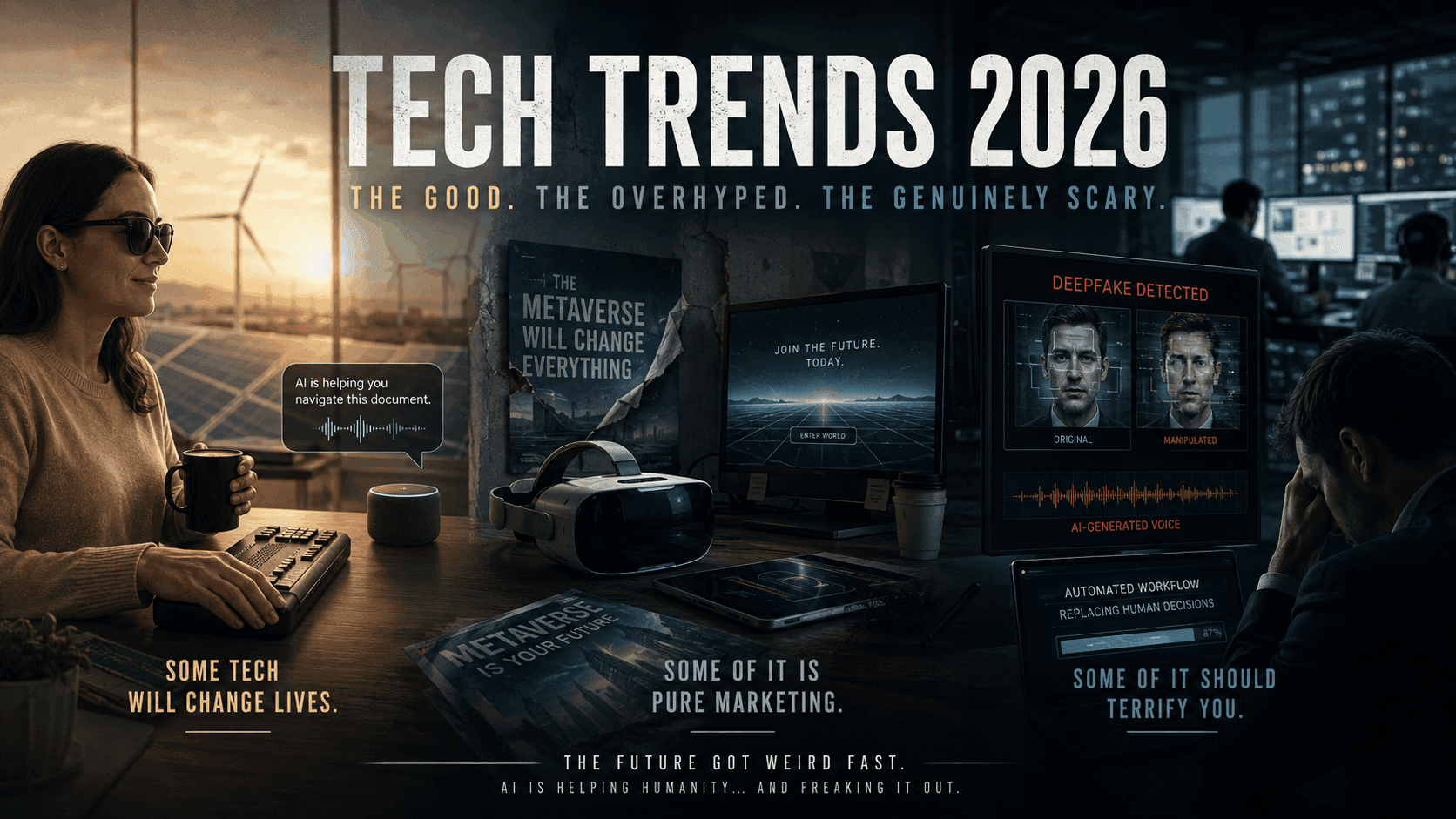
2026 feels different because we’re no longer talking about “future technology” in theory. AI systems are already writing reports, renewable energy is now powering massive data centers, and deepfake videos are becoming frighteningly convincing.
At the same time, tech companies are still selling fantasy products wrapped in billion-dollar marketing campaigns that don’t match reality.
So here’s the honest breakdown: What’s genuinely exciting, what’s wildly overhyped, and what should actually worry people.
THE GOOD
AI Accessibility Tools Are Quietly Changing Lives

One of the best uses of AI right now isn’t flashy.
It’s practical.
And for millions of people with disabilities, it’s becoming life-changing.
AI-powered accessibility tools have improved dramatically over the past few years:
- Real-time speech-to-text transcription
- AI vision assistance for blind users
- Live captioning during conversations
- Smart hearing enhancement
- Voice-controlled computing
- AI-generated image descriptions
Companies like Microsoft Accessibility, Apple Accessibility, and Google Accessibility are integrating these features directly into mainstream products instead of treating them like niche add-ons.
That matters.
Because accessibility technology historically came with two major problems:
- It was expensive
- It often felt separate from normal consumer tech
AI is helping eliminate both.
For example: A blind user can now point a smartphone camera at a room and hear AI describe the environment almost instantly. Real-time captioning can help deaf users participate in meetings without waiting for human transcription services. Voice assistants are becoming better at understanding speech impairments that older systems struggled with.
This is one area where AI hype actually undersells the real impact.
The technology isn’t replacing human ability. It’s restoring independence.
And that’s probably one of the most meaningful uses of AI we’ve seen so far.
Renewable Energy Is Powering Data Centers Faster Than Most People Realize

Here’s something surprising:
Some of the same companies building massive AI systems are also becoming some of the biggest buyers of renewable energy on Earth.
That sounds contradictory at first because AI consumes enormous amounts of electricity.
But major tech companies are aggressively investing in:
- Solar farms
- Wind energy
- Battery storage
- Water-efficient cooling systems
- Nuclear-powered future infrastructure
According to the International Energy Agency (IEA) and sustainability reports from companies like Google Sustainability, Microsoft Sustainability, and Amazon Sustainability, renewable-powered infrastructure is scaling at record speed.
Why?
Because powering AI with fossil fuels forever would become economically and politically unsustainable.
Tech companies know this.
The irony is fascinating: AI may end up accelerating green infrastructure simply because the industry needs absurd amounts of electricity to survive.
Of course, critics are right to point out that AI still has a massive environmental footprint. Training advanced models requires huge computational resources, and many data centers still rely heavily on non-renewable grids.
But compared to where the industry was even five years ago, the shift toward renewable-powered infrastructure is happening much faster than most people realize.
THE OVERHYPED
The Metaverse Still Isn’t What Tech Companies Promised

Remember when companies claimed we’d all be living inside virtual worlds by now?
Yeah. About that.
The metaverse didn’t completely fail. But it absolutely failed to match the hype.
Most people still do not want to:
- Wear bulky headsets for hours
- Attend virtual office meetings as avatars
- Socialize in cartoon worlds instead of real life
- Buy digital real estate
And despite billions spent by companies like Meta, mass adoption still hasn’t happened.
The problem wasn’t imagination. It was human behavior.
Tech executives often assume that if technology becomes possible, society will automatically want it.
That’s not how humans work.
People value convenience. And right now, the metaverse often feels less convenient than simply using a laptop or phone.
Ironically, the technology that may actually revive parts of the metaverse isn’t VR at all.
It’s AI.
AI-generated environments, AI NPCs, and lightweight mixed reality glasses may eventually create more practical use cases.
But the original vision? Digital utopia? Replacing reality?
That was massively oversold.
AI “Consciousness” Claims Are Becoming Silicon Valley’s Favorite Marketing Strategy

This trend needs more skepticism.
Fast.
Every few months, someone online claims an AI system has become:
- Sentient
- Self-aware
- Conscious
- Alive
And every time, headlines explode.
The reality is much less dramatic.
Modern AI systems are extremely good at mimicking human conversation patterns. They predict language so effectively that people emotionally project intelligence, personality, and intention onto them.
But prediction is not consciousness.
According to researchers from organizations like Stanford Human-Centered AI and MIT Technology Review, there is still no scientific evidence that current AI models possess self-awareness, emotions, or subjective experience.
What’s happening instead is:
- Anthropomorphism
- Clever marketing
- Public misunderstanding
- Viral social media exaggeration
And honestly? Some companies benefit from the confusion.
Because “our AI is almost alive” generates way more engagement than: “Our prediction model got slightly better at statistical language generation.”
AI is incredibly powerful already. It doesn’t need fake science fiction mythology attached to it.
THE GENUINELY SCARY
Deepfakes Are About to Become a Massive Trust Crisis

This is not theoretical anymore.
Deepfake technology is improving at terrifying speed.
Soon, average people may no longer be able to reliably tell whether:
- A politician actually said something
- A CEO announcement is real
- A video confession is authentic
- A voice call genuinely came from a family member
That changes society in dangerous ways.
The scariest part isn’t just fake content.
It’s plausible deniability.
In the future, real evidence may also become easier to dismiss: “That video isn’t real.” “That audio was AI-generated.”
And sometimes, they’ll be right.
Organizations like World Economic Forum and cybersecurity researchers across the industry are already warning about misinformation risks tied to synthetic media.
This could affect:
- Elections
- Financial fraud
- Journalism
- Court evidence
- National security
- Personal reputations
The internet was already struggling with misinformation.
Deepfakes may supercharge the problem.
White-Collar Job Displacement Is Moving Faster Than Many Expected

For years, automation mainly threatened repetitive factory work.
Now it’s targeting knowledge work.
And that changes everything.
AI systems are increasingly capable of:
- Writing reports
- Generating code
- Analyzing legal documents
- Automating customer support
- Creating marketing content
- Handling administrative tasks
- Processing financial data
The scary part is not total replacement overnight.
It’s gradual workforce compression.
One employee assisted by AI may soon do the work of three or four people.
That creates major economic pressure across industries like:
- Marketing
- Journalism
- Customer service
- Programming
- Design
- Administrative support
- Finance
According to research from McKinsey & Company, Goldman Sachs Research, and the World Economic Forum Future of Jobs Report, AI-driven disruption across white-collar sectors could reshape labor markets much faster than previous automation waves.
Some jobs will evolve. Some new industries will emerge.
But pretending there won’t be painful disruption is dishonest.
History shows technological revolutions create winners and losers simultaneously.
AI will likely be no different.
THE HOPEFUL FUTURE
AI-Accelerated Drug Discovery Could Save Millions of Lives

This may become one of the most important scientific breakthroughs of the decade.
Developing new medicines traditionally takes:
- Massive funding
- Years of research
- Extremely slow trial-and-error experimentation
AI is helping researchers dramatically speed up parts of that process.
Machine learning systems can now:
- Predict protein structures
- Analyze molecular interactions
- Simulate drug behavior
- Identify promising compounds faster than humans alone
Projects like Google DeepMind AlphaFold have already transformed biological research by solving protein-folding challenges that scientists struggled with for decades.
That matters because proteins are fundamental to understanding disease and treatment development.
Researchers believe AI could significantly accelerate progress in:
- Cancer treatment
- Rare diseases
- Antibiotic discovery
- Personalized medicine
- Vaccine development
This is the kind of AI advancement that deserves hype.
Not because it sounds futuristic. Because it could genuinely save lives.
Final Thoughts
The tech industry has always operated on two fuels: Innovation and exaggeration.
2026 is no different.
Some trends are genuinely transformative. Some are inflated marketing theater. And some deserve serious public concern.
The smartest approach right now isn’t blind optimism or total panic.
It’s skepticism mixed with curiosity.
Because the future of technology won’t just be decided by engineers and billionaires.
It will also be shaped by how ordinary people choose to accept, reject, regulate, or challenge the tools being built around them every day.