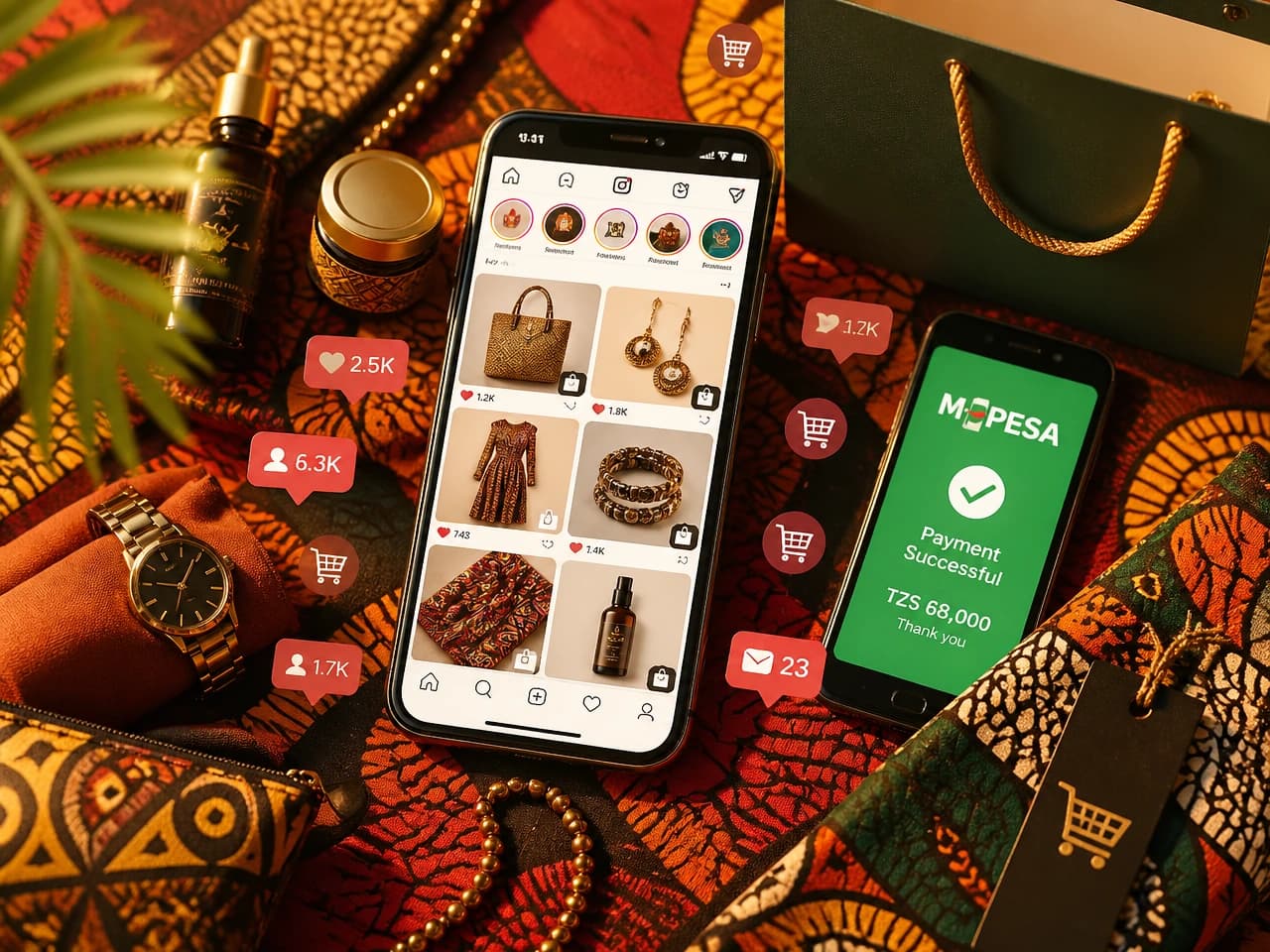
A sneaker reseller posts a new batch and the comments fill with "Bei?" before the caption is even read. A food seller in Mikocheni uploads a Reel of mandazi being packed into delivery boxes within hours, the DMs are full. A skincare brand reposts a customer's WhatsApp testimonial to their Stories. A thrift store in Kariakoo drops a flash sale announcement at 8pm and sells out before midnight.
That is the reality of online shopping in Tanzania today.
And while much of the world still imagines e-commerce through the lens of Amazon-style websites, Tanzania’s digital economy has evolved differently. Here, Instagram has quietly become one of the country’s most influential commercial platforms.
Tanzania's Digital Economy Is Growing Fast — And the Window Is Now
Tanzania may still be described as an "emerging digital market," but the numbers tell a different story.
By early 2025, the country had over 20 million internet users, and social media adoption grew by nearly 20% in a single year — faster than most markets on the continent. Instagram alone now reaches millions of Tanzanians, with its audience expanding here at a rate that outpaces much of the world.
More importantly: that audience is young, urban, and increasingly spending money on what it sees online.
This is the inflection point. The market is large enough to build a real business on, but not yet crowded enough to make it difficult. The businesses moving now will be the ones with brand recognition and customer loyalty when the next wave of internet growth arrives — and that wave is coming. Tanzania's e-commerce market is projected to reach USD 916 million by 2029, growing at nearly 9% annually.
It is what happened in Kenya. And in Nigeria before that. The early movers built positions that latecomers could not replicate.
Tanzania is at that same stage today.
Tanzanian E-Commerce Never Followed the Western Model
One reason Instagram works so well here is that Tanzania's e-commerce culture developed along its own path.
In places like the United States, online shopping became associated with websites, shopping carts, credit card entry, and automated fulfilment. Tanzania evolved around something more personal: conversation and mobile money.
The process is familiar to almost every Tanzanian internet user. Discover a product on Instagram. Send a DM or move to WhatsApp. Ask about price, size, delivery. Pay through M-Pesa or Airtel Money. Receive the product through a rider or delivery service.
According to the U.S. Commercial Service, social media platforms already dominate online buying behaviour in Tanzania, with many businesses relying entirely on Instagram and Facebook pages to sell directly to customers.
What powers it? Trust. Conversation. Mobile money.
While Western markets spent years persuading people to hand over card details to a website, Tanzania built a commerce model on human connection first. That is not a limitation. It is a structural advantage — because the behaviour existed long before the platforms caught up.
The mobile money infrastructure behind it is enormous. Services like M-Pesa, Tigo Pesa, and Airtel Money were already woven into daily Tanzanian life — used for paying bills, sending money, buying airtime, settling business transactions. According to IMARC Group, the market was valued at USD 80 billion in 2024, with over 55 million registered accounts already active across the country.
Instagram commerce simply plugged itself into a payment system people already trusted.
Why Instagram, Specifically?
Facebook is still large. WhatsApp handles enormous transaction volume. TikTok is growing fast.
But Instagram has one advantage none of the others fully replicate: it is built around visual desire.
Facebook feels cluttered — a bulletin board of mixed content. Instagram feels curated. Products appear inside aspirational content streams that naturally encourage discovery. A clothing seller in Kariakoo can post a well-lit outfit photo and reach customers across Dar es Salaam, Arusha, Mwanza, and the diaspora — without spending a single shilling on advertising.
Research on informal Tanzanian traders found that they built customer bases through three main channels: their own accounts, paid space on agents' pages with larger followings, and deliberate engagement in the comments of popular local accounts. They promoted through product photography, customer testimonials, and content designed to stop the scroll.
In many cases, these businesses operate without formal marketing teams or agencies. They simply understand how attention works online.
That is not a sophisticated strategy. That is survival instinct turned digital. And it works.
Influencers Are Just Word of Mouth, Scaled
In East African culture, trust drives purchasing decisions. Before money changes hands, people want a recommendation — from a friend, a neighbour, someone they already know.
Instagram influencers, at their best, replicate that relationship at scale.
A mother in Mwanza may not know your brand. But she knows the lifestyle creator she has been following for two years — the one who shows her home, her children, her daily life. When that creator holds up your product and says "nilikipenda sana, nunua hapa" — the sale is nearly done.
Influencer marketing has gained serious traction in Tanzania, with brands working alongside local personalities to reach specific audiences. There are now over 6,300 tracked Instagram influencers in the country — ranging from celebrities with hundreds of thousands of followers to micro-creators with tight communities in the low thousands.
For small and medium businesses, the sweet spot is clear: micro and nano-influencers, those with between 5,000 and 50,000 followers. Higher engagement rates. Lower fees. Audiences that actually read the captions and act on the recommendations.
A fashion creator with 15,000 engaged Dar es Salaam followers will convert more sales than a national celebrity with a million passive ones. Tanzanian consumers respond to authenticity and relatability. The recommendation lands because it feels personal — almost like digital word of mouth.
People trust people. Instagram just scaled the mechanism.
When the Feed Becomes the Store
The real shift is not influence. It is what happens after the influence.
Social commerce — where the discovery, the decision, and the transaction all happen within the same platform — is growing faster in Africa than almost anywhere else. Africa's social commerce market grew at a CAGR of 38.4% between 2021 and 2024, and is projected to reach USD 9.43 billion by 2030.
For Tanzania, the practical implications are significant. Research from the University of Dar es Salaam found that most Tanzanian businesses are micro and small — lacking the capital, technical resources, or management capacity to invest in traditional e-commerce platforms. Social commerce demands none of that. No website. No developer. No server costs. Just a phone, consistent content, and a credible presence.
Instagram Shops and Facebook Marketplace now give small businesses a direct route to customers across the country. Entrepreneurs are bypassing traditional retail entirely, selling directly through their feeds. For a seller in Arusha, that means you do not need a shop on Samora Avenue.
You need a compelling Instagram page.
Fashion Is Leading — But the Category List Is Growing
Look at what is selling on Tanzanian Instagram and one thing is immediately obvious: fashion dominates.
Clothing and footwear captured nearly a quarter of Africa's e-commerce revenue in 2024, driven by a young, fashion-conscious urban population with rising purchasing power. The match between fashion and Instagram is near-perfect — both are inherently visual, both reward aesthetics and attention.
But the category list is widening. Tanzania's Instagram feeds are now filled with mitumba businesses, kitenge fashion brands, beauty stores, sneaker resellers, jewellery sellers, food startups, and home décor businesses. Around 29% of Tanzanian online shoppers already use Instagram's marketplace for purchases — making it the second most-used platform after Kikuu.
The buyer profile is consistent across all of them. Tanzania's median age is 18.2 years, with the largest segment of social media users falling between 18 and 34. This is a generation that grew up with mobile phones before desktop computers, that treats Instagram as part entertainment platform, part search engine, and part shopping destination.
They are not going to a website to find you. They are going to their feed.
The Challenges Are Real — and So Are the Gaps They Create
Despite the momentum, social commerce in Tanzania still faces friction.
Trust remains a real obstacle. Many consumers are still cautious about online payments, preferring cash on delivery due to concerns about fraud and unreliable sellers. Delivery infrastructure is inconsistent outside major cities. Internet access, while growing, still does not reach the majority of the country's population.
These are genuine constraints.
But each one is also an opening — because most businesses are not solving them yet.
The seller who builds a credible, consistent Instagram presence — who shows their process, shares real customer testimonials, and is transparent about pricing — directly addresses the trust gap. The business that partners with a reliable delivery service, or uses well-known pickup points, gains a real competitive edge. The brand that puts its M-Pesa number visibly on every post removes the final friction between interest and purchase.
In a market where credibility is still developing, reputation becomes a significant advantage. The businesses earning it now are building something difficult to replicate later.
What Tanzanian Businesses Should Do Right Now
The businesses benefiting most from Instagram commerce are not the ones with the largest budgets. They are the ones that understand consistency, presentation, and audience behaviour.
Your profile is your storefront. The bio is your sign. The feed is your window display. The Stories are your shop floor. Switch to a business account, use a clean profile photo, and write clearly — in Swahili and English — what you sell and how to order.
Invest in good visuals. Poor-quality images reduce credibility immediately. A well-lit photo of your product does more selling than any caption.
Prioritise Reels. Short-form video drives Instagram's strongest organic reach right now. Show the product in use. Show the packaging. Show the process. Content people want to watch is content the algorithm rewards.
Work with the right influencer. You do not need a celebrity. You need someone your target customer actually listens to. Look for micro-influencers who align with local culture, who speak the language of your buyer, and who have a track record of driving real action — not just likes.
Make M-Pesa the last step, not a barrier. Every product post should display your payment method clearly. If you have a Lipa na M-Pesa business account, use your till name. Reduce every possible step between someone wanting your product and paying for it.
Use Swahili and English hashtags together. #mitumba, #fashionTanzania, #DarEsSalaam, #OriginalTz — local hashtags reach local buyers. Geotag your posts to the city you serve. Instagram's local discovery tools can surface your content to someone three kilometres away who is already looking.
Go live — and do it regularly. Instagram Live is the most underused tool in Tanzania's social commerce scene, and it consistently outperforms everything else in engagement. The format is interactive, personal, and creates urgency — exactly what East African commerce culture is built on. A new product drop, a flash sale, a simple Q&A. Thirty minutes live can do what thirty static posts cannot.
Tanzania's E-Commerce Future Will Be Social
Tanzania's digital commerce market is early enough that significant opportunities remain open.
The businesses building strong Instagram presences today are positioning themselves ahead of the next wave of internet growth. And unlike older e-commerce markets, Tanzania's future may never revolve around massive standalone shopping websites.
Instead, it will likely continue growing through the platforms people already use every day.
Instagram is no longer just a social media app in Tanzania. For a large and growing number of businesses, it has already become the shop itself — the storefront, the sales floor, and the payment counter, all in one scroll.
You do not need a large budget. You do not need a website. You need a consistent presence, a trustworthy brand, and a product people want.
Instagram is no longer just a social media app in Tanzania.
For many businesses, it has already become the shop itself.