Picture this for a second...
A trader in Kariakoo is livestreaming products to customers in Nairobi and Kampala without the video freezing every few minutes. A hotel in Arusha handles guest check-ins through cloud software instead of paper forms. A logistics company in Dar es Salaam tracks trucks moving across the country in real time. Somewhere in Dodoma, a doctor reviews an ultrasound scan sent from a rural clinic hundreds of kilometers away.
A few years ago, most of this would have sounded overly ambitious for Tanzania’s internet infrastructure. Today, parts of it are already normal.
But here’s the thing nobody tells you in the flashy telecom commercials: Tanzania’s 5G rollout is neither the futuristic revolution marketers promised nor the pointless gimmick critics dismiss it as.
The reality sits somewhere in the middle — and honestly, that’s what makes the story interesting.
Because 5G in Tanzania isn’t really about insane download speeds or downloading movies in seconds. Not yet, anyway. What’s actually happening is quieter, more practical, and far more connected to everyday life than most people realize.
How Tanzania Entered the 5G Era
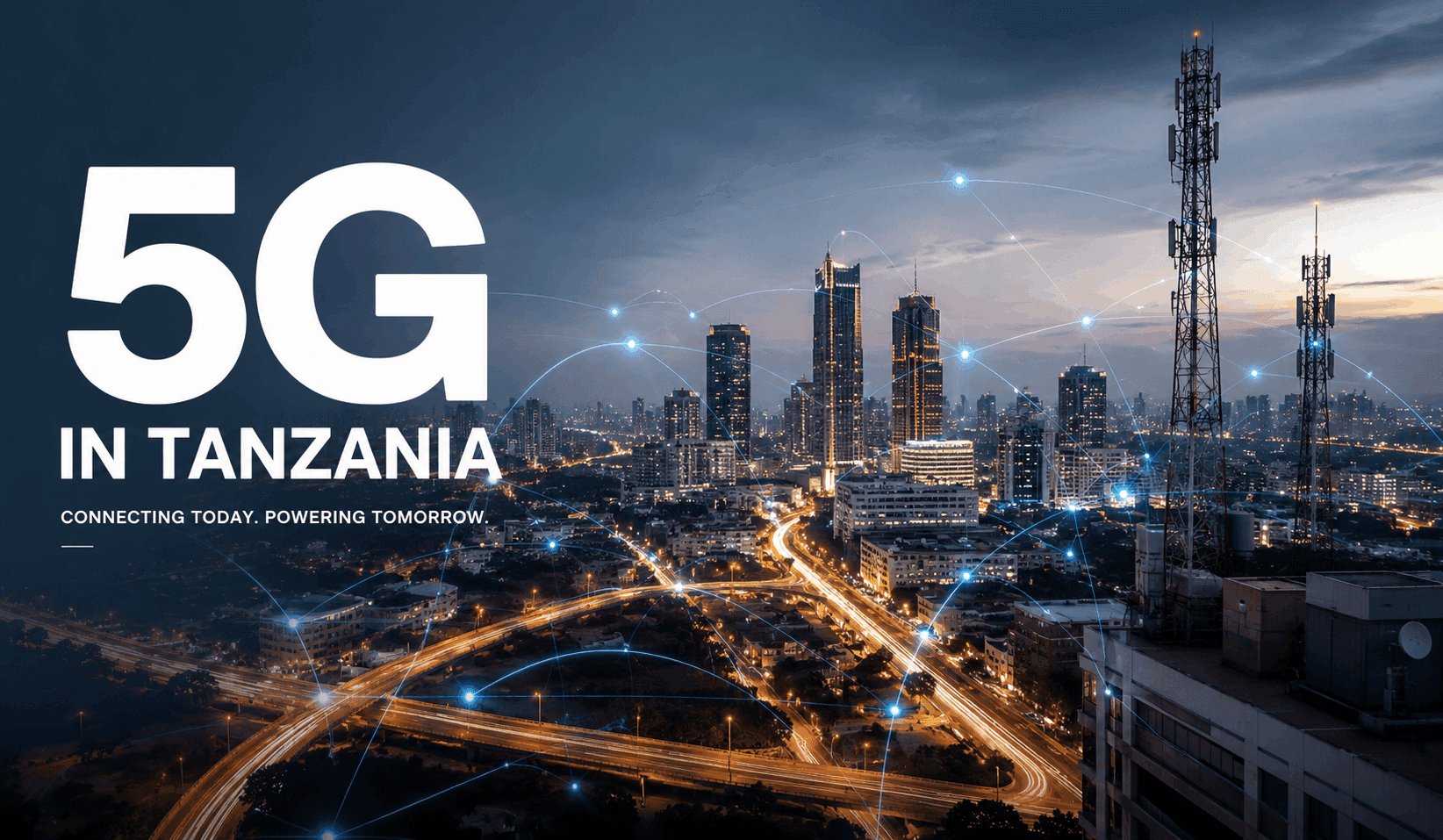
When 5G officially launched in Tanzania in September 2022, it felt like a major moment.
Vodacom Tanzania became the country’s first operator to launch commercial 5G services, starting with Dar es Salaam before expanding into cities like Arusha, Dodoma, Mwanza, and Zanzibar. The launch itself was dramatic — holograms, government officials, press coverage, the whole package.
At the time, it felt partly symbolic. Tanzania wanted to show it was ready for the next phase of digital infrastructure.
Then the rollout actually started accelerating.
Yas Tanzania (formerly Tigo) joined the race. Airtel Tanzania followed. Investments started pouring into network upgrades, fiber backbones, towers, and spectrum expansion.
And the numbers moved surprisingly fast.
Within a relatively short period, Tanzania went from zero public 5G coverage to covering a meaningful share of the population. That doesn’t mean the entire country suddenly became ultra-connected overnight — far from it — but it signaled something important:
5G stopped being a “future technology” and became real infrastructure.
That distinction matters.
What 5G Actually Feels Like on the Ground
Most people assume 5G is mainly about speed.
Technically, yes — it is faster. But for many Tanzanians already using it, the biggest difference is reliability.
Video calls don’t break as often. Uploads happen faster. Cloud apps respond quicker. Mobile payments process instantly. Streaming feels smoother.
It’s less about flashy benchmark tests and more about friction disappearing from daily digital life.
If you run a business today, internet quality directly affects how efficiently you operate. A slow connection means delayed transactions, failed uploads, interrupted meetings, frustrated customers, and wasted time.
That’s why 5G matters more to businesses than social media hype would suggest.
A modern SME in Tanzania now depends heavily on digital tools:
- WhatsApp Business
- Cloud accounting software
- Mobile money systems
- Online customer support
- Social media marketing
- Video conferencing
- Inventory platforms
None of these tools work properly on unstable networks.
So when internet quality improves, productivity improves quietly in the background.
That’s the real story.
The Quiet Revolution Most People Aren’t Talking About
One of the most underrated parts of Tanzania’s 5G rollout is Fixed Wireless Access (FWA).
Sounds technical. It’s actually simple.
Instead of waiting years for fiber internet cables to reach your office or home, telecom companies provide a 5G router that delivers broadband wirelessly.
You plug it in and suddenly your office internet stops behaving like it’s held together by prayers and backup SIM cards.
For many small businesses, this has been transformative.
A startup can now run cloud systems properly. A media company can upload large video files quickly. A remote team can hold stable Zoom meetings. An online store can process orders without constant interruptions.
And importantly, businesses can do this without expensive wired infrastructure.
That’s huge in a country where reliable fixed broadband has historically been limited outside certain urban areas.
Mobile Money Is Becoming Even More Powerful
Tanzania already had one of Africa’s strongest mobile money ecosystems long before 5G arrived.
People were sending money through phones on 2G networks years ago.
So no, 5G didn’t invent digital payments.
What it does improve is scale and responsiveness.
As mobile money ecosystems become more advanced, networks need to handle millions of simultaneous transactions, connected devices, APIs, payment confirmations, and business systems in real time.
That’s where stronger infrastructure matters.
Today, businesses increasingly rely on:
- instant payment confirmations
- QR-code transactions
- cloud-based POS systems
- mobile banking integrations
- digital invoicing
- smart inventory tracking
All of this depends on stable connectivity.
The better the network becomes, the more seamless digital commerce feels.
And in places like Kariakoo, where business moves fast, even a few seconds of delay matters.
Healthcare Might Be One of the Biggest Winners
This is where the conversation gets genuinely important.
Tanzania still faces major healthcare access challenges, especially outside urban centers. Specialists are concentrated in major cities, while many rural communities remain far from advanced medical services.
5G alone won’t solve that.
But it does remove one major barrier: connectivity.
Telemedicine has always sounded promising in theory, but poor internet quality made it frustrating in practice. Lagging video calls and slow file transfers are a serious problem when doctors need to review scans, monitor patients remotely, or consult specialists in real time.
Stronger networks change that equation.
A clinic in a rural district can potentially send medical imaging to specialists in Dar es Salaam faster. Emergency coordination becomes smoother. Remote consultations become more realistic instead of symbolic.
We’re still early in that journey, especially because most 5G infrastructure remains concentrated in urban areas.
But for the first time, the technical foundation actually exists.
And that matters.
Agriculture Is Still Waiting for Its 5G Moment
Whenever people talk about “smart farming” in Africa, it can sound disconnected from reality.
Drones. IoT sensors. Precision irrigation. AI-powered crop monitoring.
For many farmers, the more immediate concern is still reliable market access, weather information, and affordable internet.
Right now, Tanzania’s agricultural digital transformation is still largely a smartphone-and-4G story.
Farmers use WhatsApp groups. They check prices online. They connect with buyers digitally. They access agricultural advice through mobile platforms.
That alone is already changing livelihoods.
5G’s role comes later.
Over time, stronger connectivity could support things like:
- connected irrigation systems
- livestock monitoring
- weather sensors
- drone-assisted crop analysis
- smart logistics systems
But that future depends on affordability, infrastructure expansion, and device access.
It’s possible. It’s just not happening at scale yet.
The Biggest Problem Nobody Can Ignore: Affordability
This is the uncomfortable part of Tanzania’s 5G story.
The technology exists. The infrastructure is growing. But access is still uneven.
Most 5G coverage remains concentrated in cities, especially Dar es Salaam. Large parts of rural Tanzania still depend heavily on 3G and 4G connectivity.
And even where 5G exists, many people simply can’t afford compatible smartphones.
That’s the reality.
A huge portion of Tanzanians still use feature phones or lower-end Android devices. For those users, discussions about ultra-fast mobile internet feel distant.
There’s also the cost of data itself.
Because connectivity isn’t just about signal coverage. It’s about sustainable access.
Having a 5G tower nearby means very little if the average person cannot afford the device or monthly usage needed to benefit from it.
That’s why affordability may ultimately matter more than raw network speed.
So… Is 5G Actually Changing Tanzania?
Yes.
But not in the dramatic, overnight way tech marketing often suggests.
The transformation is gradual.
Businesses are operating more efficiently. Internet reliability is improving. Digital services are expanding. Remote work is becoming easier. Mobile commerce is getting stronger. Cloud systems are becoming more practical.
At the same time:
- rural access gaps still exist
- smartphone affordability remains a challenge
- electricity infrastructure still affects telecom operations
- many people are only now fully benefiting from 4G
That tension is the real story.
Tanzania’s digital transformation is happening in layers, not leaps.
And honestly, that’s how infrastructure revolutions usually work in real life.
What Happens Next?
The trajectory matters more than the hype.
Tanzania’s telecom sector has been expanding rapidly, and both government and private operators are continuing to invest heavily in network infrastructure, spectrum, and digital services.
That suggests one important thing:
5G is not slowing down.
Over the next several years, the biggest shifts will probably come from:
- cheaper smartphones
- wider rural expansion
- better fiber infrastructure
- lower data costs
- smarter business adoption
- stronger digital literacy
When those pieces combine, 5G becomes far more meaningful for ordinary people.
Not as a buzzword. Not as a futuristic slogan.
But as infrastructure people quietly build their lives and businesses around.
Final Thoughts
The most honest way to describe Tanzania’s 5G journey right now is this:
It’s real. It’s growing. It’s useful. But it’s unfinished.
For urban professionals and businesses, the impact is already visible. For rural communities, the benefits are arriving more slowly. For telecom companies, the race is still in its early stages.
And maybe that’s the most important takeaway of all.
Technology revolutions rarely arrive all at once.
They spread unevenly. They start in cities. They favor those who can afford early access. Then, slowly, they become normal.
Tanzania’s 5G story is still being written.
But for the first time, it feels less like a promise — and more like a transition already underway.