I. Why Beijing? Why Should You Care From Dar es Salaam?
Last week, the world's biggest motor show wrapped up in Beijing, China. Not Frankfurt. Not Detroit. Not Tokyo. Beijing.
If you follow cars even casually, you may have caught a headline or two about it. But if you are sitting here in Tanzania — or anywhere in East Africa and thinking "what does a Chinese car show have to do with me?", I want you to keep reading, because the answer to that question may surprise you.
The 2026 Beijing Auto Show, officially known as Auto China 2026, was not just a car show. It was a declaration. A statement from China's automotive industry now arguably the most powerful in the world that the era of the electric vehicle is not coming. It is already here. And the cars that will define how Africa drives over the next decade were on display in those 17 halls in Beijing.
I spent time deep-diving the through numerous Youtube videos and and supplemented them with reporting from multiple credible sources covering the Beijing Auto Show and I have covered the top 25 standout vehicles at the show. This article is my attempt to bring those insights home, to you, the East African reader.
Let's get into it.
II. The Scale of This Thing Is Almost Unbelievable
Before we talk about cars, let's talk about numbers, because the scale of Auto China 2026 tells its own story.
- 1,451 vehicles on display
- 181 world premieres
- 71 concept cars
- 380,000 square metres of exhibition space across two venues
- 17 halls — each filled with more EVs than the entire United States market currently offers
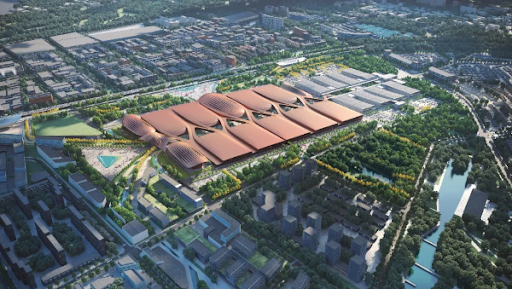 The sheer scale of Auto China dwarfs every other motor show on the planet.
According to Cui Dongshu, secretary-general of the Passenger Car Association, global auto shows are generally in a slump — Frankfurt, Detroit, Tokyo are all shrinking or cancelling. The Beijing show is moving in the exact opposite direction. It is now, without question, the only booming top-level auto show on earth.
The theme for this year's event was "Future of Intelligence" — and that theme was not decorative. Every booth, every reveal, every demo was oriented around one idea: that the future car is electric, connected, and intelligent.
One detail that struck me from the CarExpert walkthrough: Tesla was nowhere to be found. The American EV pioneer has now skipped three consecutive Beijing Auto Shows — 2024, 2025, and 2026. In a market that remains one of its most important, that absence was noticed. While Tesla sat out, Chinese brands filled 17 halls with their answer to the question of what electric mobility looks like. Draw your own conclusions.
III. The EV Stars of the Show
This section is the heart of the article. These are the vehicles and brands that stood out
1. BYD — Flash Charging, Hypercars, and a New Atto 3
BYD continues to be the brand that demands the most attention, not because of hype, but because of sheer output and innovation velocity.
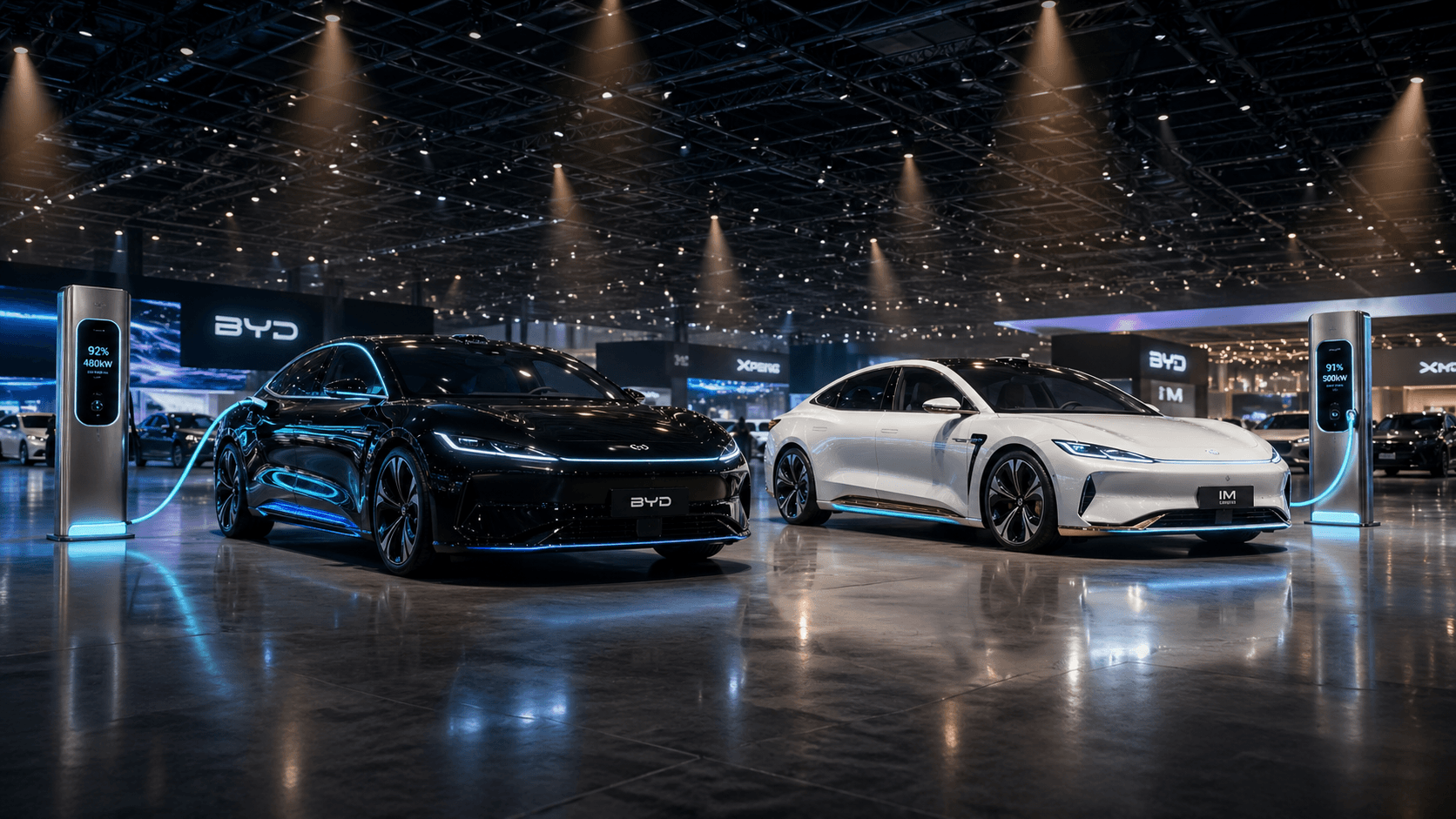
The biggest story at the BYD booth was Flash Charging 2.0 — a charging technology that can take the new BYD Atto 3 (Yuan Plus in China) from 10% to 70% in just 5 minutes, even at minus 30°C. To put that in perspective, that is barely longer than a fuel stop. BYD demonstrated this live on the show floor, charging inside a sub-zero chamber to prove cold-weather performance. The Flash Charging network peaks at 1,500 kW of output power — a figure that would have sounded like science fiction five years ago.
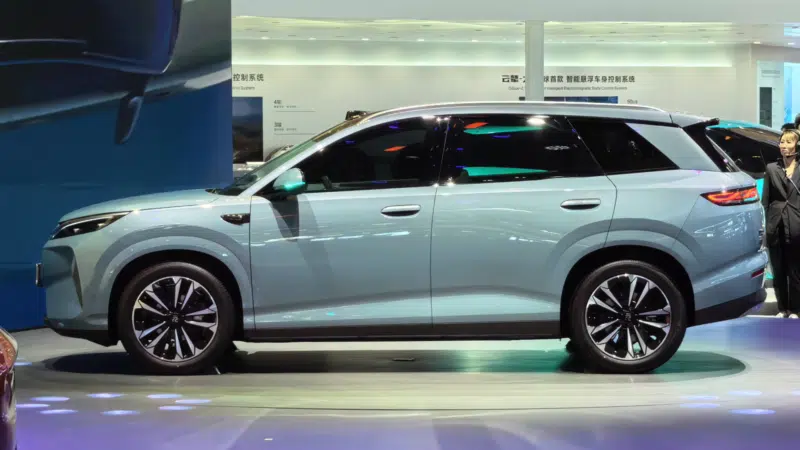 The third-generation BYD Atto 3 (Yuan Plus) — bigger, faster to charge, and already sold in Tanzania.
The new Atto 3 itself is a significant upgrade: larger in every dimension, moving to a rear-wheel drive platform, with two battery options (57.5 kWh and 68.5 kWh), ranges of 540 km and 630 km respectively, and a redesigned cabin featuring a cleaner dashboard, column-mounted gear shifter, head-up display, and a large floating touchscreen. For those of us in Tanzania who are already familiar with the current Atto 3, this update is a very big deal.
Beyond the Atto 3, BYD showcased its expanding brand family. The Denza Z — a drop-top electric hypercar pushing over 1,000 horsepower — is heading to Europe. The Yangwang sub-brand continues to push the ultra-premium envelope. And the Fangchengbao Formula X electric roadster was one of the most dramatic reveals on the floor.
2. Xpeng GX — The $58,000 SUV That Challenges Range Rover
Xpeng's reveal at this show was among the most talked-about. The GX is a full-size six-seat SUV that, visually, draws unmistakable inspiration from the Range Rover — but at a starting price of roughly $58,000, it massively undercuts its European rival.
The specs are staggering:
- 750 km of AWD range on the BEV version (800V silicon carbide platform with 5C supercharging)
- 1,585 km combined range on the extended-range EREV version
- Four proprietary Turing AI chips delivering 3,000 TOPS of computing power
- L4-ready autonomous driving hardware
- A three-tier safety system including AEB at up to 150 km/h
- Bosch steer-by-wire system and aviation-grade 6-layer redundancy
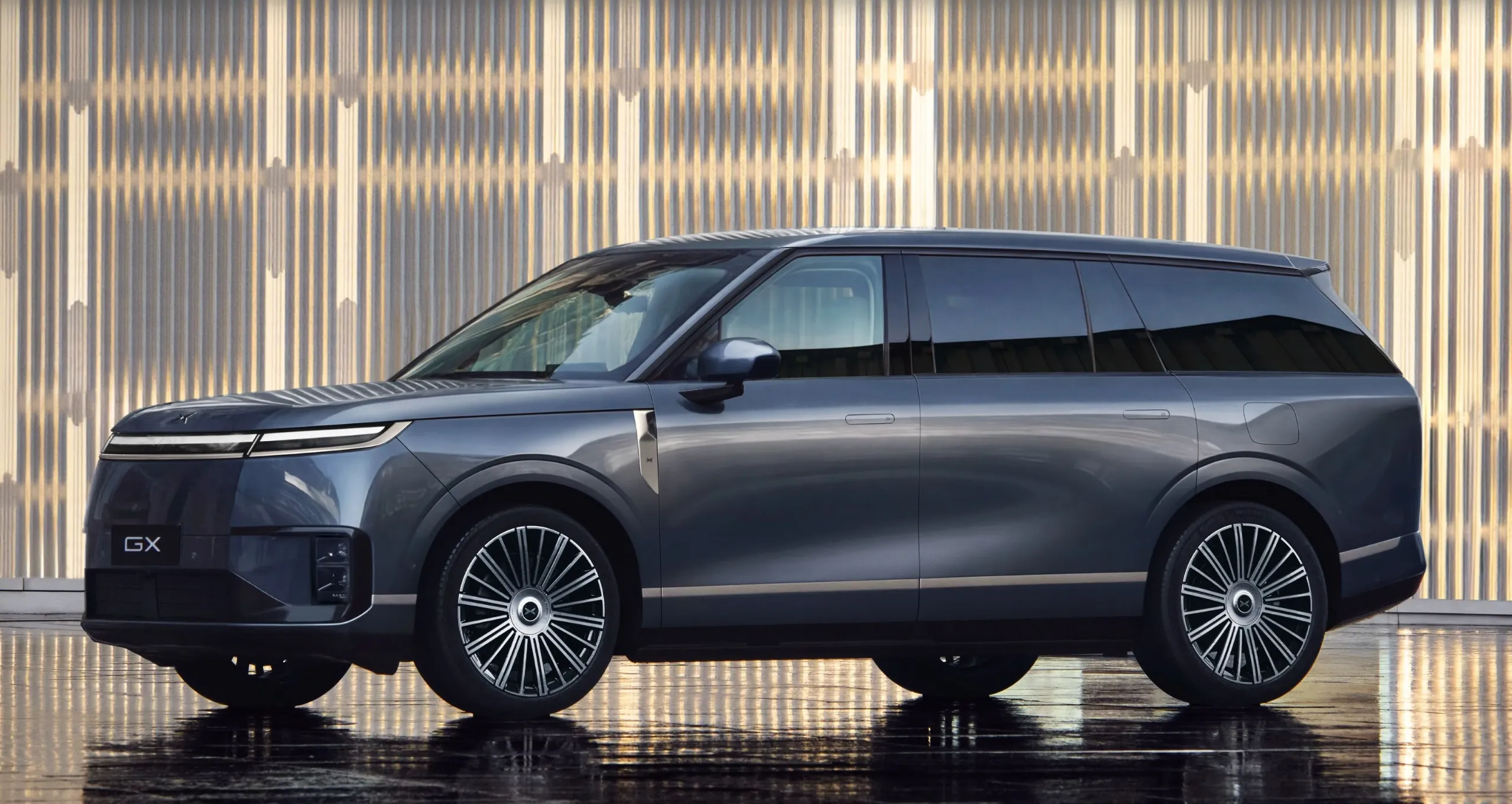 The Xpeng GX — 750km of range, L4-ready autonomy, and a starting price that undercuts Range Rover by a massive margin.
The GX also comes with Xpeng's second-generation VLA autonomous driving system — the same system that drove a 118% month-over-month surge in Ultra model orders. On the show floor as captured by CarExpert, the GX looked every bit the premium vehicle a proper statement from a brand determined to shed its mid-range image.
3. CATL — The Battery Revolution Nobody Is Talking About Enough
If BYD is the face of China's EV surge, CATL (Contemporary Amperex Technology Co. Limited) is the spine. The world's largest battery maker had its own massive booth at the show, and what it revealed there should be headline news globally.

The third-generation Shenxing lithium iron phosphate battery can charge from 10% to 98% in just 6 minutes and 27 seconds — a pace that is now genuinely comparable to refuelling a petrol car at a filling station. CATL also unveiled a landmark sodium-ion battery, securing the world's largest sodium-ion battery order in what analysts are calling a significant chemistry shift for the industry.
At the show, second-tier suppliers including CALB Group, EVE Energy, and Sunwoda also unveiled batteries capable of charging to 70% from 10% in under 10 minutes, joining what is now a full-blown ultra-fast charging war. The CarExpert walkthrough highlighted CATL's hall as one of the most technically impressive stops on the show floor.
4. Nio — Battery Swap in 3 Minutes
Nio is already well known for its battery-swapping model — a concept that sidesteps charging time entirely by simply replacing a depleted battery with a fully charged one at a swap station. At this show, Nio staged a live demonstration showing a complete battery swap in just three minutes. No plug. No wait. Drive in, swap out, drive off.

This is particularly interesting from an African infrastructure perspective. A battery-swap model requires no grid-heavy charging stations — just a stocked bank of batteries. It's a model worth watching closely as East African markets consider EV adoption strategies.
The CarExpert coverage also highlighted the Firefly — Nio's newly launched compact city EV brand targeting affordable urban mobility. Small, punchy, and designed for congested city environments, the Firefly could be an interesting fit for cities like Dar es Salaam or Nairobi in the years ahead.
5. Chery — The Budget EV You May Already Know
Chery is one of the most underrated Chinese brands when it comes to Africa strategy. At the show, their iCar lineup drew significant attention — particularly the iCar RoBox concept, a boxy, lifestyle-oriented EV that nods to the Defender aesthetic and targets younger urban buyers.
Also featured was the Chery QQ3/Q — a micro-urban EV that is remarkably affordable and designed entirely for city use. In the CarExpert walkthrough, the QQ series was called out as one of the most accessible EVs at the show, with a form factor that makes sense in dense, stop-start city environments.
The Fulwin sedan concept — also part of Chery's showcase — signals a move into more premium territory for the brand. Chery is already present in East Africa through its Omoda & Jaecoo sub-brands, with 52 dealerships across Southern Africa and active expansion plans toward Tanzania.
6. Geely, Zeekr, and the Robotaxi
Geely was one of the most ambitious exhibitors at the show, using the platform to launch what is described as China's first native robotaxi prototype — a fully driverless platform built on L4 architecture with no conventional driving controls. A production-oriented version is planned for 2027, with commercial deployment through Geely's ride-hailing service Caocao Mobility.
Geely's Zeekr sub-brand featured prominently in the CarExpert walkthrough as one of the more polished premium EV offerings on display, with strong interior quality and performance credentials. The Galaxy Light second-generation concept also debuted at the show, evolving Geely's design language with new "Galaxy Starfall" front-end aesthetics.
7. Huawei — Not Just a Phone Company Anymore
Perhaps no tech company's presence at a car show has ever been more consequential than Huawei's at Auto China 2026. Huawei is now deeply embedded across multiple automotive brands — from its Qiankun Intelligent Driving System appearing in Audi and Toyota vehicles to its own 1,500 kW megawatt charging ecosystem now being rolled out at scale.
At the show, Huawei Digital Energy positioned its charging system as a full-stack infrastructure solution — not just a fast charger, but a grid-integrated, solar-storage compatible network. This kind of thinking matters enormously for markets like Tanzania and East Africa, where the grid is unreliable. Solar-buffered charging infrastructure could bypass grid limitations entirely.
The CarExpert walkthrough also covered Aito — Huawei's vehicle partnership with Seres — and the Avatr brand (Huawei + Changan), whose Vision Xpectra concept was one of the most technically jaw-dropping vehicles at the show: pillarless coach doors, a full-length glass roof, lidar integrated into the front bumper, and a silicon carbide motor running at 99.1% efficiency.
8. The Foreign Brands — Fighting Back Hard
To their credit, the global legacy automakers did not come to Beijing empty-handed.
Volkswagen announced it will launch around 30 electrified models in China by 2027 and 50 by 2030 — launching a new model every two weeks starting this year. The ID. Unyx 09, co-developed with Xpeng, was a highlight of the VW presence as captured by CarExpert.
Toyota — historically the most EV-resistant major automaker — showed up with the bZ5 in a striking matte red finish, signalling it knows it must electrify in China or get left behind.
BMW and Mini were also present (CarExpert walked both booths), with new electric models designed specifically for the Chinese market. Hyundai announced it is "tripling down" in China with the Ioniq V — developed with local partners including Momenta and CATL.
Nissan unveiled two new concept cars, while Volvo presented its pure-electric flagship 90 family including the EX90, ES90, and EM90 for the first time together, achieving full-matrix coverage of SUVs, sedans, and MPVs. Ford also made an appearance, as did Mercedes-Benz — both brands determined not to cede the world's largest EV market without a fight.
IV. The Big Trends — My Honest Takeaways
Walking away from hours of research and footage from this show, five themes emerge clearly.
Trend 1: The Ultra-Fast Charging War Is the New Arms Race
The single biggest technical battleground at Auto China 2026 was charging speed. BYD's Flash Charging. CATL's Shenxing. Huawei's megawatt infrastructure. CALB. EVE Energy. Sunwoda. Every significant player is racing toward the same finish line: a charge time that matches a fuel stop.
BYD Flash Charging 2.0 peaks at 1,500 kW. CATL's Shenxing does 10–98% in 6.5 minutes. Nio's battery swap takes 3 minutes. The "range anxiety" argument against EVs — the idea that charging takes too long — is being systematically dismantled by Chinese engineering. For consumers who've been on the fence, this is the development that changes the equation.
Trend 2: AI and Autonomous Driving Are Becoming Standard, Not Premium
At the 2024 Beijing show, autonomous driving was still a talking point. At Auto China 2026, it is table stakes. Almost every major automaker presented some form of intelligent driving — from Xpeng's L4-ready GX to Huawei's Qiankun system embedded in Audi and Toyota vehicles, to Geely's driverless robotaxi platform.
The AI theme extended deep into in-car cockpits too. HarmonyOS dashboards, agentic AI assistants, augmented reality heads-up displays — the interior of a 2026 Chinese EV is beginning to feel more like a smartphone than a vehicle.
Trend 3: Chinese Brands Are Moving Upmarket
This is perhaps the most strategically important trend. For years, the narrative around Chinese EVs was about affordability — cheap alternatives to established brands. That narrative is obsolete.
BYD's Denza Z hypercar. Xpeng's $58,000 GX. Yangwang's ultra-premium SUVs. The Avatr Vision Xpectra with its pillarless coach doors and 99.1% motor efficiency. A DIFA supercar near the Lexus booth. Xiaomi's Vision GT, with CEO Lei Jun personally on stage.
Chinese automakers are now competing at every market segment, including supercars. The era of Chinese = budget is done.
Trend 4: Even Vacuum Cleaner Companies Are Making EVs
One of the stranger but revealing details from the show: Dreame — a company known for making robot vacuums — had a massive booth at Auto China 2026 with a red electric sports car concept. This tells you everything about the state of Chinese manufacturing confidence. The barriers to entry for EV development in China are now so low — and the supply chain so accessible — that companies entirely outside the auto industry see EVs as a credible business opportunity. CarExpert highlighted this as one of the most surreal and revealing moments of the show.
Trend 5: The Supply Chain Is the Real Superpower
One detail that goes underreported in Western media: battery makers like CATL, CALB, and EVE Energy, as well as tech suppliers like Huawei, Horizon Robotics, and Baidu Apollo, all had independent booths at the show — right alongside the car brands. This "manufacturers and suppliers in the same hall" setup was a first for Beijing, and it revealed something important: China's EV dominance is not just about the cars. It is about owning the entire stack — from raw material processing to battery chemistry, chip design, software, and charging infrastructure. That vertical integration is why Chinese EVs can be priced the way they are. And it is why nobody else can easily replicate what China is doing.
V. What Does All of This Mean for East Africa?
This is the section I want to spend the most time on, because this is where the conversation gets personal.
BYD Is Already Here in Tanzania
In late 2025, BYD opened its first brand center in Tanzania — a showroom and after-sales service hub — marking another milestone in its measured expansion across Africa. This was not accidental. BYD, along with several other Chinese brands, has identified East Africa as part of a deliberate continental strategy.
The BYD models currently available or being pursued in the Tanzanian market include the Seagull (a compact city hatchback starting around $11,800), the Dolphin (a practical family-oriented EV), the Yuan Pro SUV, the Qin L sedan, and the more premium Atto 3 and Seal. The Atto 3 in Tanzania is priced around $47,500 — not cheap, but competitive when you factor in fuel savings and lower maintenance costs over time.
Now, with the third-generation Atto 3 revealed in Beijing featuring Flash Charging and an extended 630 km range, that model's eventual arrival in Tanzania would represent a genuine step-change in EV accessibility here.
The Charging Infrastructure Problem — Real, But Solvable
Let me be honest about the challenge. Tanzania currently applies a 25% import duty on EVs plus an 18% VAT, and our charging infrastructure is limited. Grid reliability remains a genuine concern.
But here is the counter-argument: plug-in hybrids exist precisely for this scenario. BYD's Shark plug-in hybrid pickup and SEALION 6 crossover — both showcased in African market launches — do not require a charging station. They run on petrol when needed and electricity when available. Auto executives across multiple Chinese brands have acknowledged that plug-in hybrids are central to their Africa strategy precisely because of infrastructure limitations.
And as Huawei's solar-integrated charging ecosystem — demonstrated at Auto China 2026 — shows, off-grid EV charging is a solvable engineering problem. We may not need to wait for Tanzania's grid to be perfect before EVs become widely viable here.
The Leapfrog Opportunity
East Africa has a history of leapfrogging legacy technology. We did it with landlines — going straight to mobile phones. We did it with banking — going straight to mobile money. The question is: can we do it with transport?
Steve Chang, BYD's General Manager for South Africa, put it plainly: "South Africa and the rest of Africa have a very big opportunity to leapfrog from ICE into renewable energy cars."
The Sub-Saharan market is estimated at a potential 3–4 million annual vehicle sales. Chinese brands are positioning themselves now, before that market matures, because they know what happened in China when NEV penetration crossed the 10% threshold — demand exploded. Tony Liu, CEO of Chery South Africa, noted the same tipping point applies: "Once the market share of new energy vehicles reaches almost 10%, then the demand will start to explode."
We are not there yet in Tanzania. But the companies building for that moment are already on the ground.
What the African EV Ecosystem Is Growing Into
Beyond BYD and Chery, the picture is more interesting. Gotion High Tech is building what is billed as Africa's first EV gigafactory in Morocco, set to open in June 2026. BAIC is establishing a new assembly plant in Egypt targeting 50,000 units annually. Moja EV Kenya has already deployed 100 Neta electric taxis in Nairobi. And Transsion — yes, the company behind TECNO and Itel phones that dominates East African smartphone shelves — has entered the EV space with its TankVolt e-bikes, now active in Tanzania, Kenya, Nigeria, and Ethiopia.
The African EV ecosystem is being built, piece by piece, using Chinese technology at its core. Auto China 2026 was, in many ways, a preview of the vehicles and systems that will flow outward from Beijing into markets like ours over the next five years.
VI. My Final Verdict — Should We Be Excited?
Yes. With eyes wide open.
The 2026 Beijing Auto Show confirmed what those paying close attention have known for a while: China has won the first phase of the EV race. The technology gap between Chinese EVs and their global competitors is wide and — in areas like ultra-fast charging, battery chemistry, and software-defined vehicles — is still growing.
For those of us in Tanzania and East Africa, this is not a distant spectacle. It is the upstream of a current we are already swimming in. BYD is in Dar es Salaam. Chery's Omoda & Jaecoo is expanding towards Tanzania. Chinese battery tech is in the e-bikes and solar systems already deployed across the region. The brands and technologies revealed at Auto China 2026 — the new Atto 3, the CATL Shenxing battery, the Huawei solar-charging ecosystem, the Nio battery swap — will filter down into our market in some form.
The questions for us as consumers, policymakers, and enthusiasts in East Africa are: Are we ready to receive this technology thoughtfully? Are our import tax structures still fit for purpose in an EV era? Are we having conversations about charging infrastructure at a national level? And are we engaging with these Chinese brands early enough to shape how they enter our market?
The cars at Auto China 2026 do not just represent what is coming for China. They represent what is coming for all of us.
📺 All car coverage referenced in this article is drawn from the CarExpert full walkthrough of Auto China 2026 — a highly recommended watch if you want to see these vehicles in person. Supplementary reporting sourced from Electrek, CarNewsChina, SCMP, The Messenger/AP, China Global South Project, and EV24 Africa.