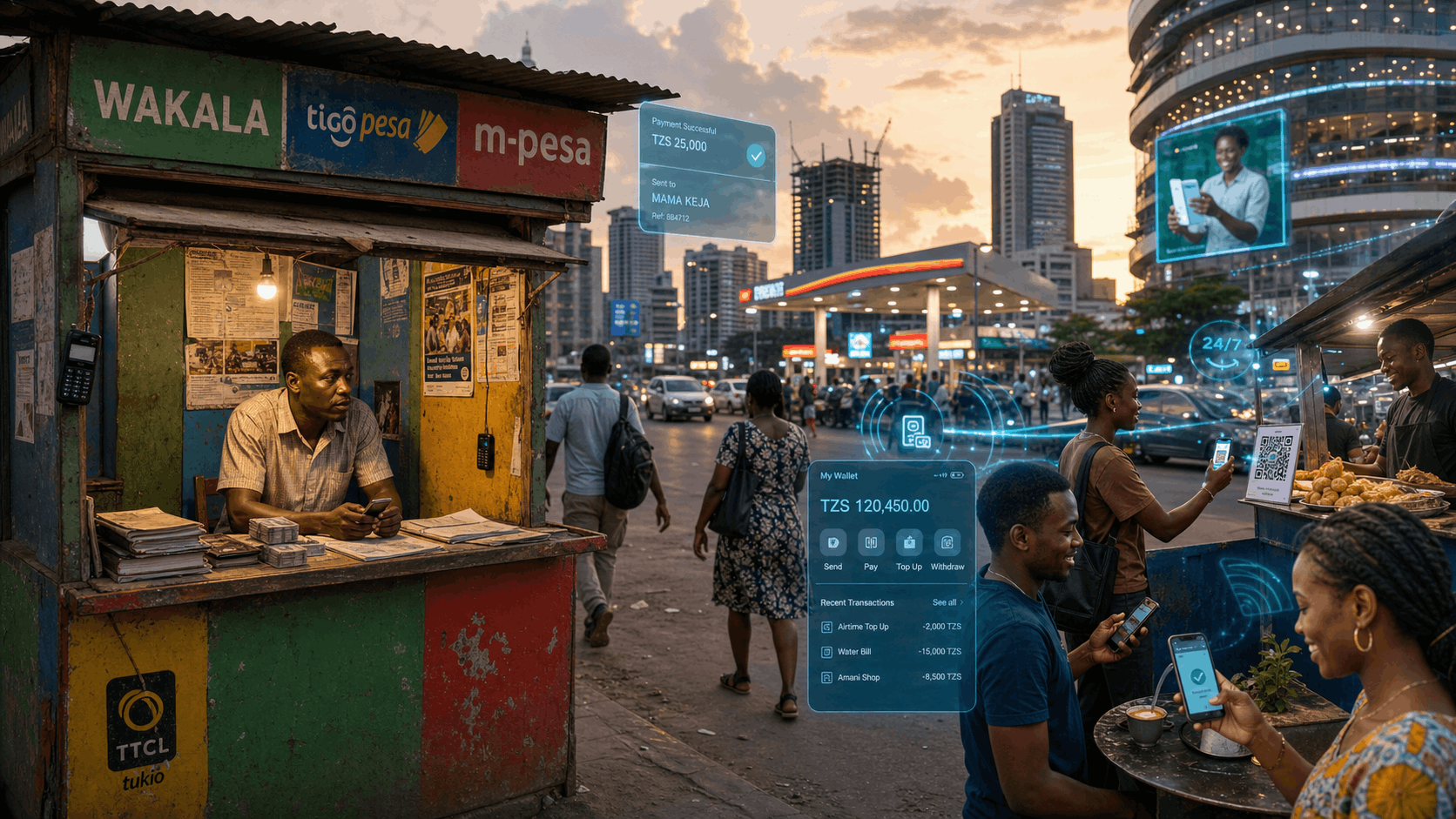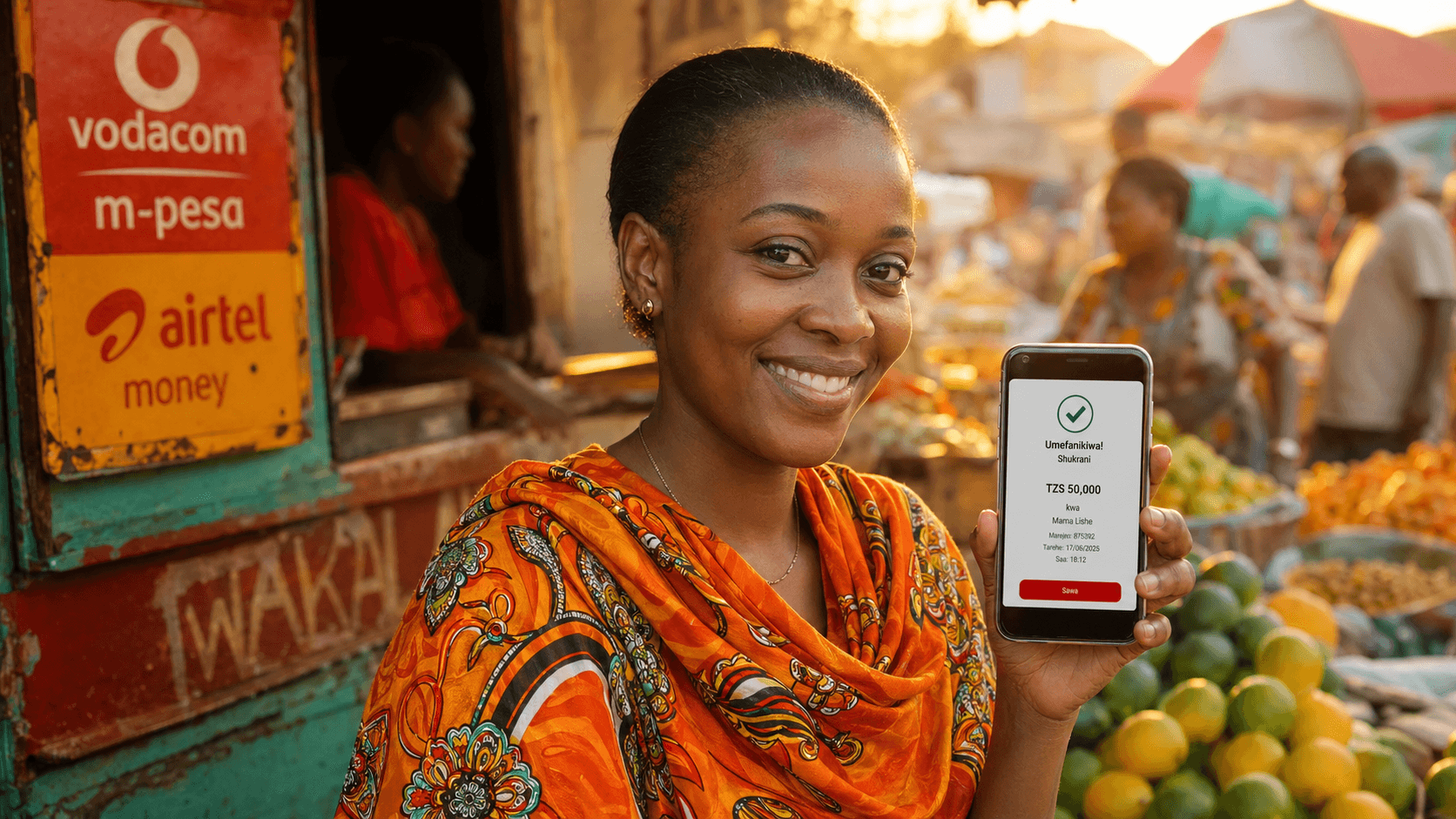
There is a woman in Mwanza. Let's call her Mama Zawadi. Every Monday morning, she used to wake up before dawn, wrap her kitenge tightly around her waist, and walk three kilometres to the nearest bank branch not to deposit millions, but to send a few thousand shillings to her daughter studying in Dodoma. She would wait in a queue for two, sometimes three hours. She would pay a fee that felt unfair for such a small transaction. And then she would walk the three kilometres back home, already behind on her day.
That was 2010. Today, Mama Zawadi does all of that from her phone, before the tea kettle has even finished boiling.
This is not just her story. This is Tanzania's story a quiet, determined, and increasingly impressive revolution in how over 63 million people move money. But amid the impressive numbers and the celebratory headlines, a fair question deserves a fair answer: How far have we really come?
The Seed That Grew Into a Forest: Where It All Began
To understand where we are, you have to go back to April 2008. That was the year Vodacom Tanzania launched M-Pesa — a year after Kenya's landmark rollout. Few people at the time imagined that this humble SMS-based service would eventually reshape the entire economy.
The early years were cautious. The Bank of Tanzania issued its first Electronic Payment Scheme guidelines in 2007, giving both banks and mobile network operators (MNOs) the legal ground to offer mobile money services. Zantel soon followed with Z-Pesa in 2008. Airtel launched Airtel Money in 2009. By September 2010, Tigo had entered the market with Tigo Pesa.
By 2012, Tanzania had nearly 100,000 mobile money agents spread across the country up from just 2,757 in 2008. The seed had become a sapling.
But there was a problem. All these services were walled gardens. A Vodacom M-Pesa customer could not send money to a Tigo Pesa customer. Every network was its own island. In a country where financial inclusion was already uneven, this fragmentation was a ceiling not a floor.
The Move That Changed Everything

In September 2014, something extraordinary happened and most of the world didn't notice.
Tigo and Airtel signed the first bilateral interoperability agreement between two competing mobile money operators anywhere in Africa. By December 2014, Tigo had connected with Zantel. The commercial launch followed in February 2015. And then, in February 2016, Vodacom announced it was connecting with both Airtel and Tigo — bringing M-Pesa into the fold.
With that final signature, Tanzania did something no country on Earth had done before: it achieved full, market-led mobile money interoperability across every major operator. A Vodacom customer could now freely send money to an Airtel customer. An Airtel user could send to Tigo. All of them, seamlessly, on one shared network.
Tanzania broke the closed-garden model for the first time, and in doing so, it built something that now has real implications for any business trying to move money in the country today.
The rest of Africa is still catching up.
TIPS: Tanzania Builds Its Own Highway
By 2018, the government and the Bank of Tanzania (BoT) took the next ambitious step — building a national, real-time payment infrastructure from the ground up. The Tanzania Instant Payment System (TIPS) was launched in 2020, and it was built entirely by Tanzanian developers, designed specifically around local needs.
Think of TIPS as the highway beneath the cars. While M-Pesa, Tigo Pesa, and Airtel Money are the vehicles people use daily, TIPS is the road that lets all of them travel freely — connecting banks, mobile money wallets, and licensed financial institutions on a single real-time clearing platform.
The results, by 2024, were staggering.
In 2024, TIPS handled 454 million transactions, nearly twice the 236 million recorded in 2023, as the number of participating institutions rose to 46. "The system has emerged as a key pillar in Tanzania's digital financial infrastructure, facilitating instant payments and promoting financial inclusion, particularly among underserved communities," the Bank of Tanzania stated.
To put that in perspective: when TIPS launched in 2020, few imagined it would be processing the equivalent of billions of dollars in under five years. And it did so while being built in-house — not outsourced, not imported.
The Numbers That Tell the Real Story

Data does not lie, even when it is inconvenient. And in Tanzania's case right now, the data is remarkably encouraging.
According to the Bank of Tanzania's National Payment System Annual Report 2024:
- The number of active mobile money users jumped by 22.2 percent to 63.2 million in 2024, up from 51.7 million the previous year.
- Mobile payment transactions increased by 26.73% to 6.41 billion, and the value of those transactions rose by 28.54% to TZS 198,859 billion.
- Mobile money agents increased by 18.97% to 1,475,281 agents in 2024 — nearly 1.5 million human touchpoints spread across the country.
- The number of merchants accepting digital payments more than doubled, rising from 657,346 in 2023 to 1.33 million in 2024.
- Virtual card registrations grew by 60.37% to 820,832 cards, processing TZS 220.15 billion in local currency and USD 187.33 million in foreign currency.
And the long-term trajectory is even more striking. Active mobile money subscriptions nearly doubled, rising from 35.3 million in 2021 to 76.5 million by December 2025, while annual transactions grew from 3.75 billion to 6.31 billion during the same period.
By the close of 2025, 72% of all SIM cards in Tanzania were linked to mobile money services — a number that, a decade ago, would have seemed like science fiction.
Beyond Sending Money: What Mobile Money Has Become
Remember when mobile money meant one thing — sending money from your phone to someone else's? That era is long gone. Tanzania's digital financial ecosystem has evolved into something far more layered.
Today, Tanzanians use mobile money platforms to pay utility bills, school fees, university tuition, taxes, and government fees — and to receive salaries and government transfers. Digital loans doubled in 2024, per Bank of Tanzania data, while digital insurance premiums reached TZS 1.4 trillion in the same year.
That last number — Payments to Business — is the one that keeps economists excited. It signals that Tanzanians are not just using mobile money for family transfers. They are paying traders at Kariakoo, settling invoices with suppliers in Arusha, and buying stock for their mama lishe businesses in Mbeya. Commerce is going digital.
The Tanzania Model: Why the World Is Watching

There's a debate that runs through fintech circles in Africa: should digital payment systems be led by the market (private sector) or by government?
Kenya chose the market route. In 2024, mobile money transactions in Kenya hit KES 8.7 trillion ($67.3 billion), equivalent to more than half of the country's GDP. The system is brilliant — but it is also one company, one platform, with enormous private power.
Tanzania chose differently. Unlike Kenya's market-led model, where Safaricom's M-Pesa dominates, Tanzania has opted for a more centralised approach, placing interoperability at the core of its digital payments strategy. TIPS is a government-backed, centrally-operated clearing system. No single company owns the highway. Every licensed operator uses it equally.
Going Regional: Tanzania Connecting to the World
Tanzania's digital ambitions are no longer confined within its borders.
This is significant. When a fish trader in Dar es Salaam can instantly pay a supplier in Kigali with the same ease she pays her bodaboda rider, regional trade transforms. The vision is a single East African digital payments corridor — and Tanzania is one of the architects drawing the blueprint.
Tanzania processed 1.3 million cross-border remittance transactions through banks in 2024, a 40.5% increase from the year prior. The direction of travel is clear.
Africa's cross-border payments market is currently valued at approximately $329 billion and is projected to reach $1 trillion by 2035. Tanzania's growing position inside that corridor matters more than ever.
But Let's Be Honest: The Gaps Still Exist
Here is where we must resist the temptation to declare victory too early. Because for every Mama Zawadi in Mwanza who now pays from her phone before breakfast, there is a farmer in Lindi who still walks to the nearest agent — if one exists at all.
The data here is sobering. As of December 2024, Tanzania had more than 52,000 financial access points including mobile money agents, bank branches, and ATMs — but coverage remains uneven across the country. In some rural districts, the number of access points sits below the national average of 4.8 per 10,000 adults, while urban areas such as Dar es Salaam have a ratio that exceeds 15 per 10,000.
Compare that to Kenya, which had over 320,000 mobile money agents nationwide in 2024 — more than six times Tanzania's total financial access points.
The rural-urban divide is real. Rural populations are less likely to own smartphones, further limiting their access to mobile services, and research confirms that rural residents face higher barriers due to lower financial literacy.
And then there is the matter of trust and digital literacy. A lack of regular internet connectivity, poor financial literacy, and limited digital competencies continue to act as significant barriers to the adoption of digital payments in Tanzania.
What Is Coming Next?

Tanzania's leaders are not resting. The roadmap ahead is ambitious.
Experts predict the next frontier will include mobile-based loans, agricultural insurance products, and deeper cross-border payment systems — all built on the rails that Tanzania has already laid.
The Bank of Tanzania issued 101 payment system licences in 2024, 59 of them to non-bank providers — signalling a clear regulatory openness to more competition, more innovation, and more players in the ecosystem.
So, How Far Have We Really Come?
Back to the question that started this story.
The honest answer is: remarkably far, but not far enough.
Tanzania has achieved things that would have seemed impossible fifteen years ago. It became the first country in the world to achieve full mobile money interoperability. It built a nationally-owned real-time payment system with its own developers. It grew to over 76.5 million active mobile money accounts by the end of 2025. It more than doubled the value of its real-time payment transactions — from $4.88 billion to $11.66 billion — in a single year. It is now connecting its payment rails to its regional neighbours.
These are not small things. They are the foundation of an economy that works for more people than it ever did before.
But Mama Zawadi's story is not yet complete for everyone. For the farmer in Singida who has no agent within ten kilometres. For the woman in Kagera who doesn't own a smartphone. For the young man in Mtwara who doesn't trust digital platforms because he has seen his neighbours lose money to fraud. For them, the revolution is still on its way.
The question going forward is not whether Tanzania can build the technology. We have proven we can. The question is whether we can close the gap between the people for whom the revolution has already arrived — and those still waiting at the door.
That is the work of the next decade.
Key Takeaways at a Glance
| Indicator | 2021 | 2024 / 2025 | Growth |
|---|---|---|---|
| Active Mobile Money Accounts | 35.3 million | 76.5 million (2025) | +116% |
| Annual Mobile Money Transactions | 3.75 billion | 6.41 billion (2024) | +71% |
| TIPS Transaction Value | — | $11.6 billion (2024) | 2x from 2023 |
| Registered Merchants | — | 1.33 million (2024) | +102% |
| Mobile Money Agents | — | 1.47 million (2024) | +19% |
| Internet Subscriptions | 25.2 million | 49.3 million (2025) | +96% |
| 4G Network Coverage | — | 91% of population | — |