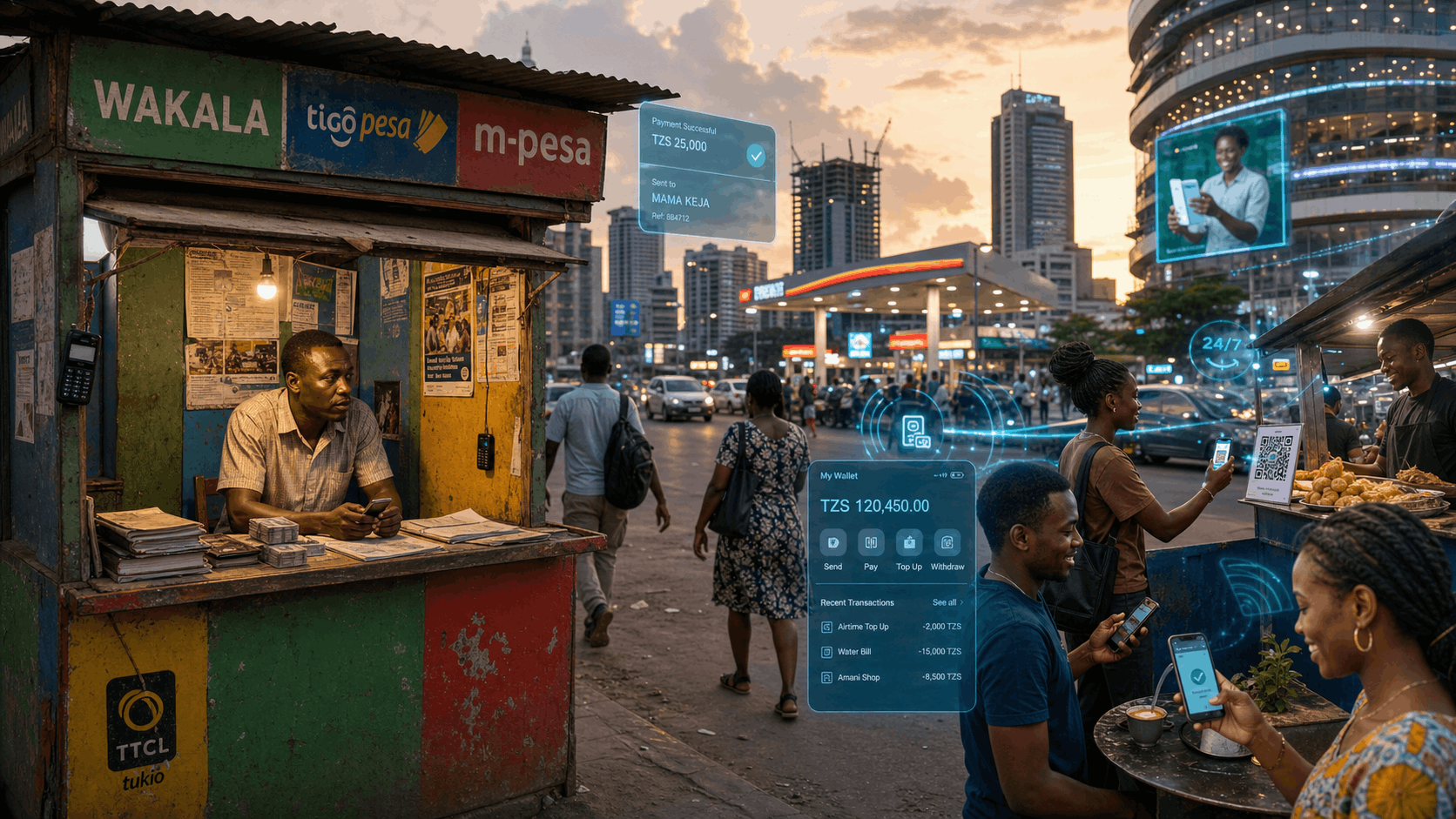
It is a Tuesday morning in Kariakoo.
A row of wakalas(mobile money agents) sits under faded telecom branding — blue, yellow, red, green. A few years ago, these booths would already have queues stretching into the street before breakfast. Today, one agent leans back in a plastic chair scrolling through TikTok. Another is selling airtime to pass time. A third has quietly added phone accessories and SIM registration to survive.
Business has slowed, and they know it.
A few metres away, a mama ntilie receives payment from a restaurant client through a QR code taped beside her counter. No cash changes hands. No queue forms. No wakala touches the transaction.
The money simply moves.
Quietly, Tanzania is entering a new phase of digital finance — one where mobile money agents are no longer the center of the ecosystem they helped build.
And most people have not fully noticed it yet.
The Wakala Built Tanzania's Real Financial System
To understand why this shift matters, you first have to understand what wakalas actually built.
For millions of Tanzanians, mobile money agents succeeded where traditional banks failed.
In the early years of mobile money, banks were still concentrated in major urban centers. Opening an account felt intimidating. ATMs were scarce outside cities. For ordinary Tanzanians — especially in rural areas — financial services were physically distant and socially inaccessible.
Then came the wakala.
A kiosk owner in Tabora suddenly became a banking point. A small duka in Mbeya became an ATM. A phone shop in Mwanza became a remittance center.
Without fancy language or fintech conferences, wakalas became Tanzania’s true financial infrastructure.
According to FinScope Tanzania, financial inclusion in Tanzania reached 76% of adults, with mobile money accounting for the overwhelming majority of that growth. (finmark.org.za)
That transformation was not powered by smartphones.
It was powered by humans.
The wakala system gave people something traditional banking often could not: proximity and trust.
And it worked at extraordinary scale.
A 2025 report by GeoPoll found that 94% of Tanzanians use mobile money services in some form — from sending money to paying bills and buying goods. (geopoll.com)
By some estimates, mobile money now contributes between 5% and 8% of Tanzania’s GDP. (medium.com)
That is not just a telecom success story.
It is one of the most significant economic transformations in modern Tanzania.
But the Queue Is Getting Shorter
The strange thing is this:
Mobile money itself is still growing rapidly.
But the need for the wakala is slowly shrinking.
That distinction matters.
For years, Tanzania’s digital finance ecosystem depended on one behavior:
Money enters the phone… then quickly exits as cash.
Now that cycle is beginning to break.
People are increasingly leaving money inside the digital ecosystem longer:
- receiving digitally,
- paying digitally,
- transferring digitally,
- shopping digitally.
And every transaction that stays digital quietly removes the agent from the equation.
Research published in the Association for Computing Machinery journal on digital financial systems found that the amount cashed out from mobile money wallets has steadily declined across Sub-Saharan Africa. (dl.acm.org)
The same study observed that many agents are now relying on secondary businesses because commissions alone are no longer enough to sustain them.
You can already see it on the streets:
- wakalas selling snacks,
- agents repairing phones,
- kiosks doubling as parcel collection points,
- booths becoming mini convenience stores.
The mobile money booth is slowly evolving from a specialized financial service point into a general survival business.
Three Things Quietly Killing the Traditional Wakala Model
This shift is not happening because of one dramatic innovation.
It is happening because multiple trends are converging at the same time.
1. Transaction Fees Are Changing Consumer Behavior
Mobile money convenience comes with a cost.
And Tanzanians are becoming increasingly sensitive to it.
A 2025 analysis estimated that Tanzanians collectively spend over $300 million annually on mobile money transaction fees. (iziraa.com)
Withdrawing larger amounts can become surprisingly expensive.
That changes behavior.
The more expensive cash withdrawals become, the more users begin searching for alternatives that allow them to keep money digital from start to finish.
Research examining Tanzania’s mobile money taxation policies found that higher transaction costs disproportionately affect lower-income households, especially in rural areas. (medium.com)
When touching your own money becomes expensive, people naturally start avoiding the touchpoint itself.
And often, that touchpoint is the wakala.
2. Smartphones Are Replacing Human Intermediaries
The second shift is technological.
As smartphone penetration rises, users no longer need a human being to complete basic financial tasks.
According to data compiled by TanzaniaInvest, smartphone penetration in Tanzania surpassed 41% by late 2025. (tanzaniainvest.com)
That percentage may still sound modest compared to developed markets.
But economically, it is transformative.
Because once a user owns a capable smartphone, they gain direct access to:
- banking apps,
- QR payments,
- savings products,
- lending services,
- investment platforms,
- merchant ecosystems.
The phone itself starts replacing physical infrastructure.
In practical terms, many users are becoming their own wakalas.
3. The System Is Now Incentivizing Digital Payments Instead of Cash Withdrawals
For years, the ecosystem revolved around cash-out behavior.
Now the incentives are changing.
In 2022, the Bank of Tanzania introduced TAN-QR — a national interoperable QR payment system designed to allow seamless payments across banks and mobile wallets. (transfi.com)
That sounds technical.
But culturally, it is massive.
Because the more merchants accept direct digital payments, the less consumers need to withdraw cash first.
The change is already visible:
- restaurants accepting QR scans,
- fuel stations processing wallet payments,
- salons receiving direct transfers,
- small businesses using payment apps instead of cash.
The merchant is becoming the new battlefield of Tanzania’s financial system.
Not the wakala booth.
Tanzania's New Financial Infrastructure Is Becoming Invisible
One of the most important things happening right now is also the easiest to miss:
Payments are becoming invisible.
Money increasingly moves:
- inside apps,
- between APIs,
- through QR codes,
- across interoperable systems,
- without physical interaction.
The infrastructure layer itself is changing.
The Bank of Tanzania’s Tanzania Instant Payment System (TIPS) processed more than $11 billion in 2024, enabling real-time transfers between wallets and bank accounts. (transfi.com)
At the same time, companies like Selcom, ClickPesa, and DPO Group are quietly building the connective tissue behind digital commerce — payment gateways, merchant APIs, embedded finance tools, and unified payment systems.
Most consumers never see this layer.
But businesses do.
And businesses are increasingly optimizing for direct digital payments rather than cash handling.
A recent study found that 84% of Tanzanian SMEs adopted digital payment methods within the past two years. (tanzaniainvest.com)
That statistic matters more than it initially appears.
Because once businesses normalize digital payments, customer behavior tends to follow permanently.
The Uncomfortable Reality for Wakala Businesses
The decline of the traditional wakala model is not just a fintech story.
It is also a livelihoods story.
For years, agency businesses became one of the most accessible forms of entrepreneurship in Tanzania:
- relatively low startup costs,
- steady customer traffic,
- predictable commissions.
Thousands of families built income streams around mobile money agency work.
Now many are entering an uncertain transition period.
Some telecom companies already appear aware of the pressure.
Mixx by Yas recently introduced a Wakala App and financing initiatives targeting agents — effectively acknowledging that survival may now require evolution beyond simple cash-in and cash-out services. (therespondents.co.tz)
The modern wakala may need to become:
- a logistics point,
- a digital onboarding center,
- a fintech support hub,
- a merchant services agent,
- or a broader neighborhood commerce operator.
Because relying purely on withdrawal commissions is becoming increasingly difficult.
And deep down, many agents already know it.
But Tanzania Is Not Going Fully Cashless Tomorrow
Despite all these changes, it would be a mistake to declare the wakala “dead.”
That would ignore the realities of Tanzania itself.
Large parts of the country still depend heavily on:
- cash economies,
- feature phones,
- unreliable internet access,
- and face-to-face trust systems.
For an elderly customer in Tanga or a farmer in Songea, the human relationship with a local agent still matters enormously.
Technology adoption rarely happens evenly.
Urban Tanzania moves first. Rural Tanzania follows later. And often at a very different pace.
According to projections by IMARC Group, Tanzania’s mobile money market could grow from roughly $80 billion in 2024 to over $220 billion by 2033. (imarcgroup.com)
So the ecosystem itself is not shrinking.
It is evolving.
The real question is who benefits from that evolution — and who gets left behind.
The Bigger Question Nobody Is Asking
For years, the wakala represented something bigger than transactions.
They represented accessibility.
Human interaction.
Trust.
The shift toward invisible finance creates incredible efficiency. But efficiency and inclusion are not always the same thing.
As Tanzania races deeper into app-driven finance, difficult questions are starting to emerge:
What happens to users without smartphones? What happens during network failures? What happens when digital fees become unavoidable? What happens to elderly users who trust people more than interfaces? And what happens to the thousands of small entrepreneurs whose businesses depended on the old system?
Maybe the real story is not that the wakala is disappearing.
Maybe the real story is that Tanzania is redefining what financial access looks like — in real time.
And perhaps the most important question of all is this:
As money becomes increasingly digital, instant, and invisible… who gets excluded when the human middleman disappears?