Tanzania's connectivity story is one of Africa's most compelling tech transformations. As of Q4 2025, the country has reached 106.9 million total telecom subscriptions, with internet penetration climbing above 82%, according to the Tanzania Communications Regulatory Authority (TCRA). Mobile broadband remains the dominant mode of access, representing over 99% of all internet connections.
What does that mean for you as a consumer? Simply put: the router you buy in Tanzania needs to work with the country's network reality not against it. With 4G coverage now reaching 94.2% of the population and 5G coverage at 30.1% (as of December 2025), your router should be equipped to make the most of these networks. Fixed-line fiber subscriptions, while growing, remain modest at around 123,000 FTTH connections nationally, making cellular-based routers the go-to solution for most Tanzanian households and businesses.
Whether you're in Dar es Salaam enjoying Vodacom's expanding 5G footprint, running a guesthouse in Arusha, managing a small business in Mwanza, or setting up a home office in Dodoma this guide covers the best Wi-Fi routers you can find in Tanzania right now.
What to Look for in a Router in Tanzania
Before diving into specific models, here are the key factors you should evaluate based on Tanzania's unique context:
1. 4G/5G LTE SIM Card Support
Since fiber broadband remains limited and most Tanzanians rely on mobile networks, a router with a built-in SIM card slot is often more practical than a traditional wired broadband router. Look for compatibility with local carriers like Vodacom, Airtel, Yas (formerly Tigo), and Halotel.
2. Band Compatibility
Tanzanian operators use specific LTE frequency bands. Ensure the router supports common African/East African LTE bands — primarily FDD-LTE B1 (2100 MHz), B3 (1800 MHz), B8 (900 MHz), and B20 (800 MHz). For 5G compatibility, look for sub-6GHz 5G support.
3. Number of Simultaneous Connections
Family homes and small offices in Tanzania often need to connect smartphones, laptops, TVs, and security cameras all at once. Aim for routers that support at least 20–32 simultaneous connections.
4. Dual-Band (2.4 GHz + 5 GHz) Support
Dual-band routers let you separate heavy-traffic devices (streaming, video calls) onto the faster 5 GHz band, while keeping basic browsing on 2.4 GHz — reducing congestion across your network.
5. Power Outage Resilience
Power interruptions are a reality in many parts of Tanzania. Consider routers with low power consumption, or pair your router with a small UPS (Uninterruptible Power Supply) for uninterrupted internet during brief outages.
6. Price & Availability
Most routers are sourced from online marketplaces like Jiji, local tech shops in Dar es Salaam's CBD, or dealers from brands like Empire Online Shopping. Prices are quoted in Tanzanian Shillings (TZS) below, with approximate USD equivalents.
The Best Wi-Fi Routers in Tanzania (2025)
🏆 1. TP-Link TL-MR6400 — Best Overall 4G LTE Router
Price: TZS 120,000 – 180,000 ($45–$60)
Wi-Fi Standard: N300 (802.11n)
Bands: Single-band 2.4 GHz
SIM Card: Yes (Micro SIM)
Max Devices: 32
LTE Speed: Up to 150 Mbps download
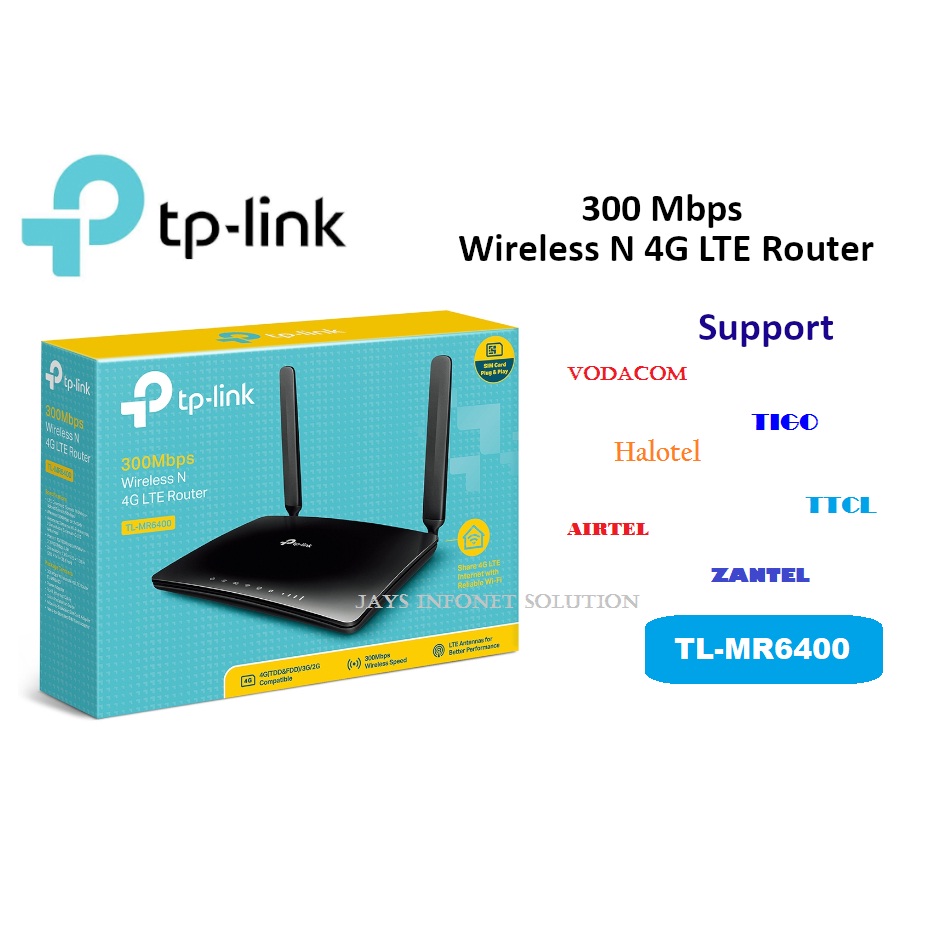
The TP-Link TL-MR6400 is arguably the most popular and practical router for the average Tanzanian household. It features a built-in 4G LTE modem with a SIM card slot, meaning you simply insert your Airtel, Vodacom, or Yas SIM card and you're online — no cable modem, no ISP technician, no hassle.
Why it excels in Tanzania:
- Plug-and-play compatibility with SIM cards from 100+ countries, including all major Tanzanian carriers
- Connects up to 32 Wi-Fi devices — ideal for family homes and small offices
- Supports 3G/4G networks and can fall back to 3G in areas with weaker coverage
- The Ethernet WAN port lets you switch to wired broadband if fiber becomes available in your area
- Widely available on Jiji and at TP-Link dealers across Tanzania
Limitation: Single-band only (2.4 GHz), so it's not ideal for heavy-bandwidth tasks like 4K streaming. Not 5G-ready.
⚡ 2. TP-Link Archer MR600 — Best Dual-Band 4G+ Router
Price: TZS 280,000 – 380,000 ($105–$145)
Wi-Fi Standard: AC1200 (Wi-Fi 5)
Bands: Dual-band 2.4 GHz + 5 GHz
SIM Card: Yes (Micro SIM)
Max Devices: 64
LTE Speed: Up to 300 Mbps download (4G+ Cat6)
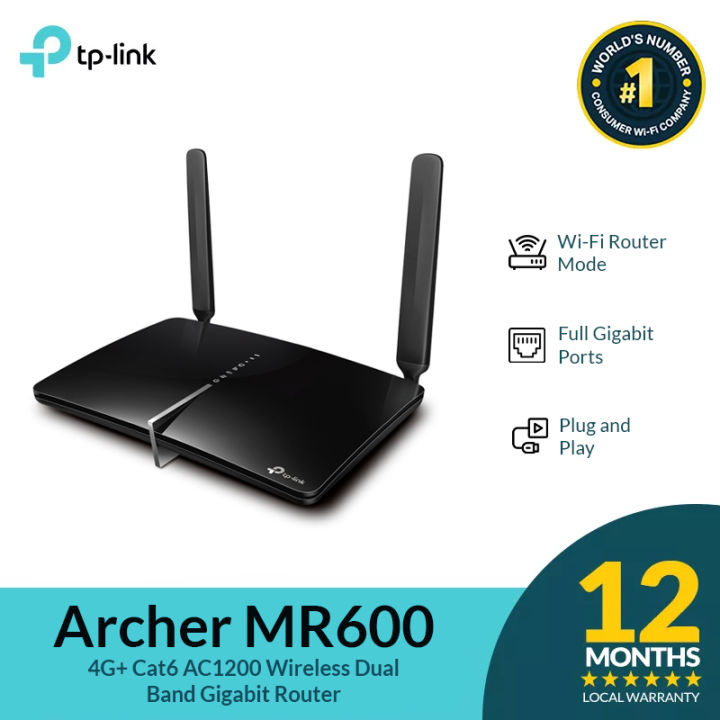
If you want the best 4G experience money can buy in Tanzania without going to enterprise hardware, the Archer MR600 is your router. It uses 4G+ (also called LTE-A, or Cat6) technology, which combines two LTE bands simultaneously — effectively doubling your potential speeds over standard Cat4 routers.
Why it excels in Tanzania:
- 4G+ Cat6 delivers real-world speeds noticeably faster than single-band LTE routers in Vodacom and Airtel's advanced network zones in Dar es Salaam and Arusha
- Dual-band AC1200 Wi-Fi means you can stream HD video on 5 GHz while browsing on 2.4 GHz simultaneously
- Four Gigabit LAN ports allow reliable wired connections for desktops, smart TVs, or NAS devices
- Compatible with TP-Link OneMesh — so you can add a range extender later to cover a larger compound
- Supports up to 64 wireless clients
Best for: Medium to large households, home offices, small business owners, and tech-forward users who want to future-proof their setup.
💰 3. TP-Link TL-MR100 — Best Budget 4G LTE Router
Price: TZS 80,000 – 110,000 ($30–$42)
Wi-Fi Standard: N300 (Wi-Fi 4)
Bands: Single-band 2.4 GHz
SIM Card: Yes (Micro SIM)
Max Devices: 32
LTE Speed: Up to 150 Mbps download
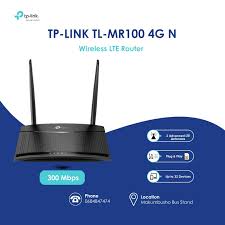
The TL-MR100 is a stripped-down, no-frills 4G LTE router that gets the job done at an accessible price. It's one of the most listed routers on Jiji in Tanzania, and for good reason — it's affordable, widely available, and works reliably with local networks.
Why it excels in Tanzania:
- Excellent value for basic home internet: social media, WhatsApp video calls, YouTube in HD
- Parental controls and guest network support built-in via the Tether app
- Compact and easy to set up — a great first router for families upgrading from smartphone hotspot sharing
- Draws very little power, keeping your electricity costs down
Limitation: Not dual-band. For multi-device households with heavy streaming needs, consider upgrading to the MR600.
🌐 4. TP-Link Archer AX1500 (AX10/AX12) — Best Wi-Fi 6 Router for Fiber Users
Price: TZS 200,000 – 280,000 ($75–$105)
Wi-Fi Standard: Wi-Fi 6 (802.11ax), AX1500
Bands: Dual-band 2.4 GHz + 5 GHz
SIM Card: No (wired broadband only)
Max Devices: 40+ (Wi-Fi 6 OFDMA)
Speeds: Up to 1500 Mbps combined
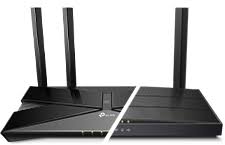
With fiber subscriptions growing in Dar es Salaam and other urban centers (TCRA data shows fiber download speeds averaging 35 Mbps, upload 31.8 Mbps), a next-generation Wi-Fi 6 router makes increasing sense for those with a fiber connection from providers like TTCL, Vodacom, or Smile.
The Archer AX1500 introduces OFDMA technology, which allows the router to communicate with multiple devices simultaneously rather than in sequence — a massive efficiency improvement for homes where 10+ devices are connected at once.
Why it excels in Tanzania:
- Future-proof: Wi-Fi 6 handles dense multi-device environments better than older AC (Wi-Fi 5) routers
- Gigabit WAN port supports Tanzania's growing fiber broadband infrastructure
- WPA3 security standard keeps your network protected
- Available at select tech shops in Dar es Salaam and listings on Jiji
Best for: Urban fiber broadband users in Dar es Salaam, Arusha, Mwanza, or Dodoma looking to upgrade their home network for smart home devices, 4K streaming, and remote work.
🏢 5. MikroTik hAP ac² (RB952Ui-5ac2nD) — Best for Small Business & Tech Users
Price: TZS 145,000 – 250,000 ($55–$95)
Wi-Fi Standard: AC1200 (Wi-Fi 5)
Bands: Dual-band 2.4 GHz + 5 GHz
SIM Card: No
Ports: 5 x Gigabit Ethernet
PoE Output: Yes (Port 5)

MikroTik is a Latvian brand with a strong following among Tanzania's IT professionals and internet service providers. The brand has official distributors in Arusha, Tanzania, and is widely used by local ISPs for both access point deployment and network management. The hAP ac² is their best mid-range home/SMB offering.
Why it excels in Tanzania:
- Runs RouterOS, one of the most powerful and flexible router operating systems available — giving IT-literate users deep control over firewall rules, bandwidth management, VPN, and traffic shaping
- Dual-band AC1200 performance with five Gigabit ports
- PoE output on Port 5 allows powering a MikroTik outdoor access point — great for extending Wi-Fi coverage to a yard, parking area, or shop front
- Extremely popular with Tanzania's network engineers and businesses that need granular control
- Shopit.co.tz, a trusted Tanzanian IT dealer since 2012, stocks MikroTik products with delivery nationwide
Limitation: Not beginner-friendly. RouterOS has a steep learning curve. If you're not technically inclined, stick with TP-Link or D-Link.
Best for: Small businesses, internet cafés, guesthouses, tech-savvy home users, and network professionals.
📡 6. Huawei 4G Router 3 Pro (B535) — Best Premium 4G Home Router
Price: TZS 300,000 – 450,000 ($115–$170)
Wi-Fi Standard: AC1167 (Wi-Fi 5)
Bands: Dual-band 2.4 GHz + 5 GHz
SIM Card: Yes (Nano SIM)
LTE Speed: Up to 300 Mbps (Cat7/Cat12 depending on variant)
Ports: 4 x Gigabit Ethernet

The Huawei 4G Router 3 Pro is a premium home router that combines a powerful 4G LTE modem with dual-band Wi-Fi in a sleek, all-in-one package. Huawei is available across Tanzania via e-commerce listings and select dealers, and this model is a step above most TP-Link equivalents in terms of raw LTE performance and build quality.
Why it excels in Tanzania:
- Dual-core Balong chipset delivers maximum 4G LTE download speeds of up to 300 Mbps — excellent for homes in Vodacom or Airtel's strong 4G coverage zones
- Four built-in high-gain 4G antennas (two internal + two external ports) for improved signal stability in areas with moderate coverage
- Dual-band Wi-Fi with smart band steering — your devices automatically connect to the optimal band
- Supports 100+ Mbps broadband via LAN for hybrid wired-wireless setups
- Clean web management interface — easier than MikroTik for most users
Best for: Power users and families who want a premium 4G LTE experience with reliable coverage and speeds, especially in urban and peri-urban Tanzania.
🕸️ 7. TP-Link Deco X55 (2-Pack) — Best Mesh Wi-Fi System
Price: TZS 650,000 – 900,000 ($245–$340)
Wi-Fi Standard: Wi-Fi 6 (AX3000)
Bands: Dual-band 2.4 GHz + 5 GHz
Coverage: Up to ~370 m² per unit
Max Devices: 150+
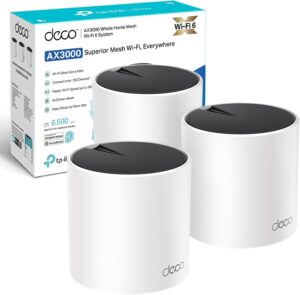
For large homes, multi-story buildings, or businesses where a single router creates dead zones, a mesh Wi-Fi system is the answer. The TP-Link Deco X55 uses Wi-Fi 6 technology and can be set up as a 2-node or 3-node system (or more), all managed from a single app — one network name, seamless roaming.
Why it excels in Tanzania:
- Eliminates dead zones in large compounds, guesthouses, or multi-room offices
- Wi-Fi 6's OFDMA and MU-MIMO handle dozens of simultaneous connected devices efficiently
- HomeShield security suite provides basic network protection, parental controls, and QoS — all through the Deco app
- Works with the TP-Link OneMesh standard, so you can add compatible extenders as needed
- Available via import or select Dar es Salaam tech retailers
Limitation: Requires a wired broadband connection or a separate 4G router as the gateway. It is a premium investment but worth it for large spaces.
Best for: Large homes, guesthouses, hotels, corporate offices, schools, and anywhere a single router simply can't reach.
📶 8. D-Link DWR-M920 — Best Portable/Budget MiFi Option
Price: TZS 90,000 – 220,000 ($34–$53)
Wi-Fi Standard: N150 / N300
Bands: Single-band 2.4 GHz
SIM Card: Yes (Micro SIM)
LTE Category: Cat4 (up to 150 Mbps)
Battery: Built-in (portable use)
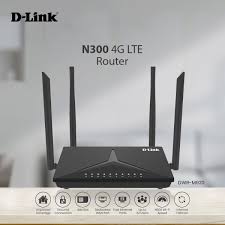
For travelers, freelancers, and people who move between locations, the D-Link DWR-M920 offers a compact, portable 4G MiFi solution that works with all major Tanzanian SIM cards. D-Link has 59+ listings on Jiji in Tanzania and is a well-established brand in the market.
Why it excels in Tanzania:
- Compact and portable — carry your Wi-Fi hotspot anywhere you go
- Built-in battery for on-the-go use
- Works with Airtel, Vodacom, Yas, Halotel, and TTCL SIM cards
- Affordable entry point for reliable 4G sharing
Best for: Frequent travelers, field workers, students, and those who need internet on the move across Tanzania.
Quick Comparison Table
| Router | Type | Wi-Fi | SIM Slot | Best For | Price (TZS) |
|---|---|---|---|---|---|
| TP-Link TL-MR6400 | 4G LTE | N300 (2.4GHz) | ✅ | Overall best budget 4G | 120K–160K |
| TP-Link Archer MR600 | 4G+ | AC1200 Dual-band | ✅ | Best 4G dual-band | 280K–380K |
| TP-Link TL-MR100 | 4G LTE | N300 (2.4GHz) | ✅ | Budget pick | 80K–110K |
| TP-Link Archer AX1500 | Fiber/Wired | Wi-Fi 6 AX1500 | ❌ | Best for fiber users | 200K–280K |
| MikroTik hAP ac² | Wired/Advanced | AC1200 Dual-band | ❌ | SMB/tech users | 145K–250K |
| Huawei 4G Router 3 Pro | 4G LTE | AC1167 Dual-band | ✅ | Premium 4G home use | 300K–450K |
| TP-Link Deco X55 (2-pack) | Mesh Wi-Fi 6 | AX3000 Dual-band | ❌ | Large spaces | 650K–900K |
| D-Link DWR-M920 | Portable MiFi | N150/N300 | ✅ | Travel & mobility | 90K–140K |
Where to Buy Wi-Fi Routers in Tanzania
Here are the most reliable channels to purchase routers in Tanzania:
- Jiji — Tanzania's largest online classifieds marketplace. Both new and used routers are listed here with competitive prices. Exercise basic caution and meet sellers in safe public locations or request delivery.
- Empire Online Shopping (empire.co.tz) — A reputable Dar es Salaam-based retailer stocking TP-Link and Ubiquiti equipment.
- Shopit.co.tz — An established IT equipment dealer since 2012, specializing in MikroTik and other networking brands with nationwide delivery.
- Telecom Operator Outlets — Vodacom, Airtel, and Halotel retail shops sell locked routers bundled with their own data plans. Prices start from TZS 50,000–130,000. Note that carrier-locked routers only work with that operator's SIM card.
- Downtown Dar es Salaam Tech Shops — Kariakoo and the CBD area around Samora Avenue have numerous electronics and IT shops where you can find TP-Link, Huawei, and MikroTik equipment.
Tips for Maximizing Your Router Performance in Tanzania
1. Place your router strategically. Position your router centrally in your home or office, ideally elevated, and away from walls and interference sources like microwaves or cordless phones.
2. Use the right SIM plan. A powerful router is only as fast as your data plan allows. Vodacom and Airtel offer home broadband bundles with unlimited data at around TZS 70,000–115,000/month — significantly better value than day-by-day data packages.
3. Check your operator's network in your area. Use apps like Speedtest by Ookla or your carrier's coverage map before committing to a router type. If your area only has 3G coverage, investing in a high-end 4G router won't yield the speeds it's rated for.
4. Invest in a UPS. To keep your internet running during Tanzania's occasional power outages, a small UPS (Uninterruptible Power Supply) unit for TZS 80,000–150,000 will keep your router alive for 30–90 minutes — enough to get through most outages.
5. Keep firmware updated. All major router brands release firmware updates regularly. Keeping your firmware current ensures you get security patches and sometimes performance improvements. For TP-Link, this is easy via the Tether app.
Final Verdict
Tanzania's internet ecosystem is primarily mobile-first, and your router choice should reflect that reality. For most homes and small businesses, a TP-Link 4G LTE router — the TL-MR6400 for budget-conscious buyers or the Archer MR600 for those wanting higher speeds — represents the sweet spot of price, availability, and performance in 2025.
If you have a fiber broadband connection in an urban center, the TP-Link Archer AX1500 brings genuine Wi-Fi 6 future-proofing at a reasonable cost. For large spaces, go mesh. For technical users, MikroTik's RouterOS ecosystem offers unmatched control and flexibility.
Tanzania's internet infrastructure is improving rapidly. With 5G coverage at 30% of the population and growing, and fiber subscriptions expanding month over month, the routers you invest in today should be ready for tomorrow's speeds.
Prices are approximate and may vary based on market conditions, currency fluctuations, and supplier. Always confirm current prices with your retailer before purchasing.