
So you've learned to code. You've built projects, watched tutorials, maybe even landed a small freelance gig. But now you're staring at a blank document wondering: how do I write a CV that actually gets me hired in Tanzania?
I've been there. And in this guide, I'll walk you through exactly how to write a tech CV that works not just for Tanzanian employers, but also for remote-first companies across East Africa and beyond. I'll use real examples from my own CV and explain the why behind every section, so you leave with a document that actually opens doors.
Let's get into it.
Why Your CV Matters More Than You Think
Before we get into the nuts and bolts, let's be honest about something: most CVs in Tanzania are bad. Not because people aren't talented, but because nobody teaches us how to write one properly.
Here's the reality: according to Indeed, more than 75% of qualified applications are rejected before a human even sees them — filtered out by Applicant Tracking Systems (ATS). An ATS is software that companies use to automatically scan and rank CVs before a recruiter reads a single line. If your CV isn't formatted correctly or doesn't use the right keywords, it never even makes it to human eyes.
And it's not just a Western problem. Africa Career Networks confirms that ATS adoption is growing steadily across Africa, especially in tech, IT, and financial services precisely the industries most of us are targeting.
The good news? Once you understand the rules, it's not that hard to win.
Section 1: Choose the Right CV Format
The first decision you need to make is your format. According to CV Chap Chap, the reverse-chronological format is the most widely accepted in Tanzania and across East Africa, and it also plays best with ATS systems.
What does that mean? Simple your most recent experience comes first. Recruiters want to immediately assess where you are now, not where you were five years ago.
For tech roles specifically, here's what to keep in mind about length:
- Fresh graduate or under 3 years experience → 1 page
- 3–5 years experience → 1–2 pages
- Senior/specialist with 5+ years → 2–3 pages max
Morgan McKinley puts it well: in specialised fields like tech and data, up to three pages are acceptable but only if every single line earns its place.
Formatting rules that keep ATS happy:
- Use a standard font: Arial, Calibri, or Times New Roman, size 11–12pt
- Single-column layout only — no fancy side columns
- No tables, graphics, text boxes, or logos — these confuse ATS parsers
- Save as
.docxunless the job listing specifically asks for PDF
Section 2: The Header — Your Digital Business Card
Your header is the very first thing a recruiter sees. Keep it clean, professional, and complete.

What to include:
- Full name (large, prominent)
- Phone number with country code (
+255 ...) - Professional email address
- City and country (Dar es Salaam, Tanzania)
- GitHub profile link
- LinkedIn profile link
What NOT to include in a tech CV header:
- A passport photo (unless specifically requested it's not standard for tech roles)
- Your date of birth or marital status (these are irrelevant and can open the door to unconscious bias)
- Your full physical address city and country is enough
Notice how the header above immediately communicates the person's specialisation ("Full-Stack Software Engineer"), years of experience, and core stack (TypeScript · React · Node.js). A recruiter knows within three seconds who they're reading about.
Pro tip: Make your GitHub link real and active. For tech jobs, a recruiter will click it. An empty GitHub profile is almost as bad as not having one.
Section 3: The Professional Summary — Your 30-Second Pitch
This is the most underrated section on a tech CV. Most people either skip it entirely or write something vague like "hardworking and motivated individual seeking opportunities." That tells an employer exactly nothing.

Your summary should answer three questions in 3–5 sentences:
- Who are you? (Your role and experience level)
- What can you do? (Your core technical skills and track record)
- What makes you different? (Something that sets you apart)
Here's a strong example:
Self-taught Full-Stack Software Engineer with 3+ years of hands-on experience designing, building, and shipping scalable web and backend systems. Proficient in TypeScript, React, and Node.js, with a solid track record delivering production-grade applications for clients and personal projects. Experienced in integrating frontend interfaces with RESTful APIs, PostgreSQL databases, and modern DevOps workflows including CI/CD, Docker, and Kubernetes.
Notice what this summary does well:
- It's specific not just "developer" but "Full-Stack Software Engineer"
- It mentions a concrete time frame (3+ years)
- It names actual technologies (TypeScript, React, Node.js, PostgreSQL, Docker, Kubernetes)
- It uses the word "production-grade" this signals to employers that these aren't just tutorial projects
According to Career Group Africa, recruiters spend only a few seconds scanning each CV so your summary needs to immediately communicate your direction and value.
Section 4: Technical Skills — The Section Recruiters Search First
For tech roles, this is arguably your most important section. ATS systems are often configured to specifically search for technical keywords, and if yours aren't there, you won't make the cut even if you're fully qualified.

Organise your tech skills into clear categories:
| Category | Example |
|---|---|
| Languages | TypeScript · JavaScript · Python · Go · Java |
| Frontend | React · Next.js · React Native · HTML5 · CSS3 |
| Backend | Node.js · Express · Django · FastAPI · GraphQL |
| Databases | PostgreSQL · Prisma · SQL · NoSQL |
| DevOps & Cloud | Git · GitHub Actions · Docker · Kubernetes |
| Practices | TDD · Agile/Scrum · Code Reviews |
Important rules for the skills section:
- Only list skills you can actually speak to in an interview. If you put "Kubernetes" and can't explain what a Pod is, you'll be exposed.
- Mirror the language in the job description. If the posting says "React.js" and you write "ReactJS," some ATS systems will treat those as different things. As Afro Ant highlights, keyword misalignment is one of the most common reasons strong candidates are filtered out.
- Don't list "Microsoft Word" or "Google Docs" these are not tech skills.
Section 5: Professional Experience — Show Impact, Not Just Activity
This is where most Tanzanian tech CVs fall apart. People write what they did instead of what they achieved. There's a massive difference.
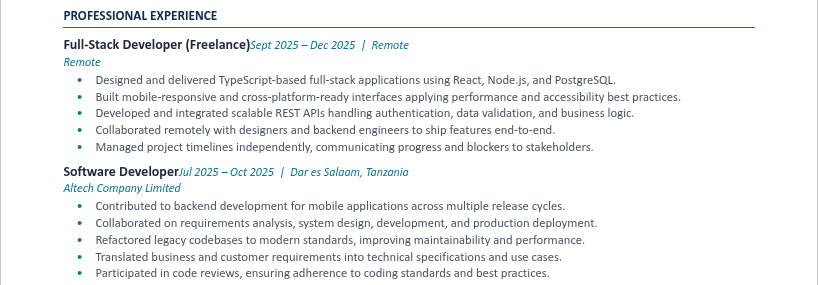
Weak bullet point:
Worked on the company's web application.
Strong bullet point:
Designed and delivered TypeScript-based full-stack applications using React, Node.js, and PostgreSQL, reducing API response time by 40%.
See the difference? The second one tells us what you built, how you built it, and what impact it had. Whenever possible, add numbers: percentages, user counts, time saved, performance improvements.
Structure each role like this:
Job Title | Company Name
Month Year – Month Year | City, Country

• Action verb + What you did + Technology used + Result/Impact
• Action verb + What you did + Technology used + Result/Impact
Use strong action verbs: Designed, Built, Developed, Integrated, Optimised, Refactored, Deployed, Collaborated, Led, Implemented.
A note on self-taught and freelance experience: Don't be ashamed of it. Tanzania's tech ecosystem has many brilliant self-taught developers. List freelance work as "Full-Stack Developer (Freelance)" with dates and a description of what you delivered. List personal projects under their own section (more on that below). As Robert Walters Africa notes, for projects, describe your role, the skills you used, and the results achieved this demonstrates practical application that employers care about.
Section 6: Education — Where to Place It and What to Include
Resume Example notes that in the Tanzanian job market, formal education is highly valued by employers. However, for tech roles especially if you have work experience your education section should come after your experience, not before.

If you're a fresh graduate with no work experience: Put education first.
If you have work experience (even freelance): Put experience first, education after.
What to include:
- Degree name
- University name
- Year range (e.g., Nov 2024 – 2027)
- City, Country
- Key relevant courses (especially for tech: Algorithms, Data Structures, OOP, OS, Web Development)
- Current status if still enrolled: "Currently enrolled expected graduation 2027"
You do NOT need to include:
- Your O-Level or A-Level results (unless you're a fresh graduate with nothing else)
- Every single course you took
- Your CGPA/GPA unless it's impressive (3.5+ or equivalent)
Section 7: Projects — The Section That Wins Tech Jobs
Here's an uncomfortable truth: in the tech industry, your projects matter more than your degree. A recruiter hiring a React developer cares more about seeing a deployed React application than knowing you passed Introduction to Computing.

For each project, include:
- Project name (make it memorable)
- Tech stack — list the specific technologies
- One-line description of what it does
- GitHub link (or live link)
- 2–3 bullet points describing what you built and any notable features
Example:
TaskFlow — Project Management App Stack: TypeScript · React · Node.js · PostgreSQL · Prisma · Docker
A full-stack project management app featuring user authentication, Kanban boards, real-time task updates, and role-based access control. Deployed with a CI/CD pipeline via GitHub Actions.
🔗 github.com/your-username/taskflow
What makes a good project for your CV?
- It's deployed somewhere (not just local)
- It solves a real problem (even a small one)
- It has a README that explains what it does
- The code is clean enough that you'd be comfortable showing it in a code review
If your GitHub links go to empty repos or 3-file tutorial copies, they hurt more than they help. Fix the repos first, then add the links.
Section 8: Certifications & Courses — Proof of Continuous Learning
Tanzanian employers, as noted by Resume Flex, appreciate candidates who invest in continuous learning. For self-taught developers especially, certifications are how you demonstrate structured knowledge.
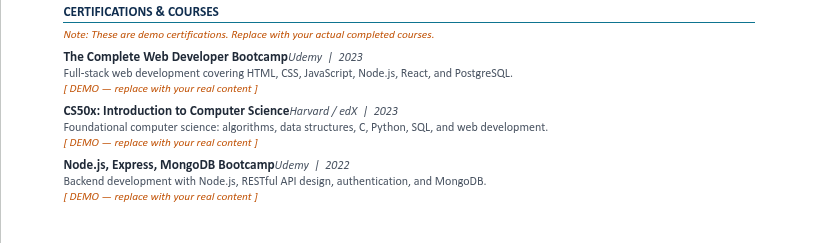
Format:
Course Title | Platform | Year
Brief description of what you learned (1 line)
High-value certifications for Tanzanian tech CVs:
- CS50x (Harvard/edX) — widely recognised, signals rigorous CS fundamentals
- The Odin Project completion certificates
- AWS Cloud Practitioner or similar cloud certifications
- Google's Professional Developer certifications
- Meta's React Developer Certificate
- Udemy bootcamp completions (Wes Bos, Jonas Schmedtmann, Brad Traversy)
Important: Only list real certifications you've completed. If a recruiter asks you about your "CS50x" certificate and you can't explain what a hash table is, that's an embarrassing conversation. Honesty always wins.
Section 9: Languages — An Underrated Advantage
For East African tech professionals, listing your languages is a genuine competitive advantage not just filler.

| Language | Level |
|---|---|
| Swahili | Native |
| English | Professional |
| French | Basic — A2 level |
If you're applying to companies that serve local markets — fintech apps, government systems, NGOs, SACCOs native Swahili is genuinely valuable. For remote jobs with international companies, strong English is non-negotiable.
As Resume Flex points out, for multinational companies, stick to English but mention Swahili proficiency under skills. For local SMEs and community-focused work, bilingual competence signals cultural adaptability.
Section 10: References — The Tanzania-Specific Rule
Here's one key difference between the Tanzanian job market and Western markets: in Tanzania, employers expect to see 2–3 references listed directly on your CV. The Western convention of writing "References available upon request" doesn't go down well here.

For each reference, include:
- Full name
- Job title and company
- Email address
- Phone number
Always contact your references before listing them. Nothing derails an application faster than a reference who's surprised to get a call and doesn't know what to say about you.
Section 11: Volunteer Work & Community Involvement
If you've mentored developers, facilitated workshops, contributed to open source, or organised tech events list it. This is especially powerful for junior and mid-level candidates in Tanzania who are still building a formal work history.

Tanzania's tech community is small but growing. Contributing to it — through the Buni Innovation Hub, iHub, local bootcamps, or even online communities — signals maturity, initiative, and leadership. These are qualities Tanzanian employers value, and they help tell the story of who you are beyond your code.
Common CV Mistakes to Avoid
Before you hit send, run your CV through this checklist:
- ❌ Spelling and grammar errors — Proofread three times. Then get someone else to proofread it.
- ❌ Generic objectives like "seeking a challenging position" — Replace with a specific, targeted summary.
- ❌ Listing responsibilities instead of achievements — What did you accomplish, not just what were you assigned to do?
- ❌ Outdated or non-working links — Test every GitHub link, LinkedIn URL, and portfolio link before sending.
- ❌ Inconsistent formatting — Different font sizes, random bold text, misaligned dates all signal carelessness.
- ❌ Demo project links — If your CV says
github.com/your-username/taskflow, replace it with a real link before applying. - ❌ Photo on every CV — For tech roles, a photo is generally not needed unless specifically requested.
- ❌ Keyword stuffing — EDLIGO warns that ATS systems are smart enough to flag unnatural keyword repetition and will rank your CV lower.
The ATS Test: Can Your CV Actually Be Read?
Before submitting your CV anywhere, do this quick test recommended by Morgan McKinley: paste your CV into Notepad or a plain-text editor. If the layout breaks, symbols disappear, or sections lose their order your CV will not parse correctly through ATS and it needs to be simplified.
The rule of thumb from RecruitMyMom is simple: avoid CV templates with graphics, tables, or columns. A clean, text-based layout in Arial or Calibri at 11–12pt with standard bullet points and headings will outperform a beautifully designed Canva template every time when it comes to getting past the machines.
Where to Find Tech Jobs in Tanzania and East Africa
Once your CV is ready, here are the platforms to use:
- GreatTanzaniajobs — Tanzania's most active professional job board
- Nafasi.io — Tanzania's premier job platform with one-tap apply
- Cosmoquick — Used across East Africa, good for remote roles
- LinkedIn — Essential for visibility to international and remote-first companies
- Mabumbe — For government Jobs
- Profdir — For job in Tanzania
- Dproz — For techjobs in Tanzania
- Andela Talent Network — For developers looking for fully remote, internationally paid roles
- GitHub Jobs / Remote OK — For remote-first tech companies worldwide
- Fuzu — Used across East Africa, good for remote roles
Final Thoughts
Writing a strong tech CV in Tanzania is not about making it look fancy — it's about making it clear, honest, and targeted. Tell your story with specifics. Show what you've built. Prove that you keep learning. And make sure the machines can read it before the humans do.
Your CV is not just a document. It's the first version of the product that is you — and as a developer, you already know: ship often, iterate based on feedback, and always test before deploying.
Good luck. see you at the top.
Sources referenced in this article: CV Chap Chap · Resume Example · Resume Flex · Nafasi.io · Career Group Africa · Robert Walters Africa · Africa Career Networks · Morgan McKinley · EDLIGO · RecruitMyMom · Afro Ant