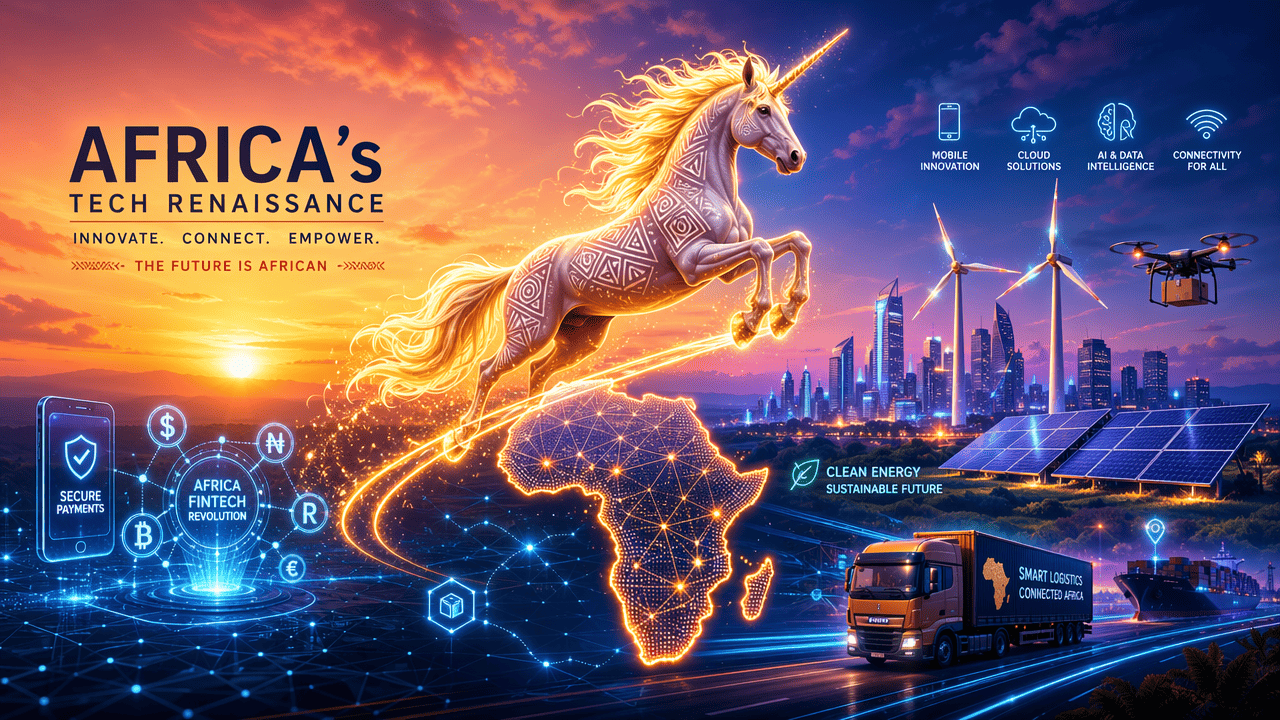
Africa’s unicorn club remains small by global standards, but the signal coming out of the ecosystem in 2025–2026 is much clearer than it was a few years ago: fewer companies, stronger fundamentals, and a more disciplined path to scale.
As of early 2026, the continent counts roughly nine confirmed unicorns. Names like Flutterwave, OPay, Wave, Tyme Group, and Moniepoint still dominate the list—and they tell a consistent story: fintech continues to be Africa’s most reliable path to scale.
But what’s more interesting isn’t the current list. It’s what’s happening just below it.
Why This Moment Matters
If you zoom out, the African startup market has been through a correction. Funding slowed, valuations compressed, and growth-at-all-costs lost its appeal.
According to the African Private Equity and Venture Capital Association, private capital activity began stabilizing in 2025. That doesn’t mean the money is back to peak levels—it means investors are being far more selective.
And that selectivity is shaping the next generation of breakout companies.
What we’re seeing now is a clear bifurcation:
- A small group of scaled, capital-efficient unicorns
- A larger pipeline of “soonicorns” being forced to prove real business fundamentals
In other words, becoming a unicorn in Africa is getting harder—but also more meaningful.
The Current Unicorn Playbook
Most of Africa’s unicorns share three traits:
1. They operate in financial infrastructure Payments, banking rails, remittances—these remain the deepest, most urgent problems across African markets.
2. They scale across borders early Domestic scale alone is rarely enough. The strongest players expand regionally to unlock real volume.
3. They monetize quickly Unlike some global peers, African startups don’t have the luxury of long, unprofitable growth cycles.
This is why fintech still dominates the unicorn class. It’s not just investor bias—it’s structural demand.
The Next Wave: Companies to Watch
The next set of African unicorns will likely look different—not necessarily in sector, but in how they grow.
1. M-Kopa
M-Kopa is one of the most credible near-term candidates. The company has done something many startups struggle with: combining scale with profitability.
Its model—financing everyday assets through micropayments—has quietly reached millions of underbanked customers. Add reported profitability and continued fundraising momentum, and you have a business that looks increasingly “public-market ready,” not just venture-backed.
That distinction matters.
2. Stitch
Stitch represents a different kind of bet: infrastructure over consumer.
Instead of competing for end users, it builds the rails that other companies rely on. That’s a harder story to tell early—but once trust is established with developers and merchants, infrastructure platforms tend to scale faster and stickier than consumer apps.
In a fragmented payments landscape like Africa’s, that’s a powerful position.
3. LemFi
Remittances remain one of Africa’s largest financial flows—and one of its most inefficient.
LemFi is betting on simplifying cross-border money movement for the diaspora. The opportunity is obvious: reduce cost, improve speed, and handle compliance better than incumbents.
If it executes well, it’s not just a fintech story—it’s a global payments story with African roots.
4. PalmPay
PalmPay sits in the crowded but still expanding consumer fintech space.
The challenge here isn’t growth—it’s retention and monetization. Many apps can acquire users in large African markets. Fewer can turn those users into consistent revenue.
PalmPay’s path to unicorn status will depend on whether it can deepen engagement beyond basic transactions.
5. Moove
Moove is one of the more interesting hybrid models—sitting at the intersection of mobility and embedded finance.
It finances vehicles for drivers, effectively turning transport demand into a credit engine. That’s a smart way to unlock value in markets where asset ownership is a major barrier.
If it scales efficiently, it could define a new category: mobility-driven fintech.
6. Spiro
Spiro represents a broader shift: climate and energy are becoming investable at scale in Africa.
Electric mobility, in particular, touches multiple high-growth themes—urban transport, energy transition, and financing. That combination makes it attractive to both venture and strategic investors.
It’s still early, but the direction is clear.
Sector Signals: Where the Next Unicorns Will Come From
Fintech remains dominant—but it’s evolving. The next winners won’t just move money; they’ll build deeper financial ecosystems.
Mobility is gaining momentum, especially models that combine logistics with financing.
Energy is moving from “impact narrative” to “scalable business,” particularly in distributed power and solar.
Healthtech and proptech are still early—but the underlying demand is massive, which leaves room for breakout players.
What Actually Creates a Unicorn in Africa Today
The formula has shifted.
It’s no longer enough to:
- grow fast
- raise large rounds
- expand aggressively
Today’s unicorns—and tomorrow’s—need to demonstrate three things clearly:
1. Revenue quality (not just GMV or user growth) 2. A believable path to profitability 3. The ability to raise late-stage capital at defensible valuations
That last point is critical. Capital hasn’t disappeared—it’s just more disciplined.
The Bottom Line
Africa’s next unicorn won’t emerge from hype cycles. It will come from companies that have learned to operate in constraint: limited capital, complex markets, and demanding customers.
That’s why startups like M-Kopa, Stitch, LemFi, PalmPay, Moove, and Spiro are attracting attention. Not because they’re growing fast—but because they’re starting to look like durable businesses.
And in this market, durability is the real signal.