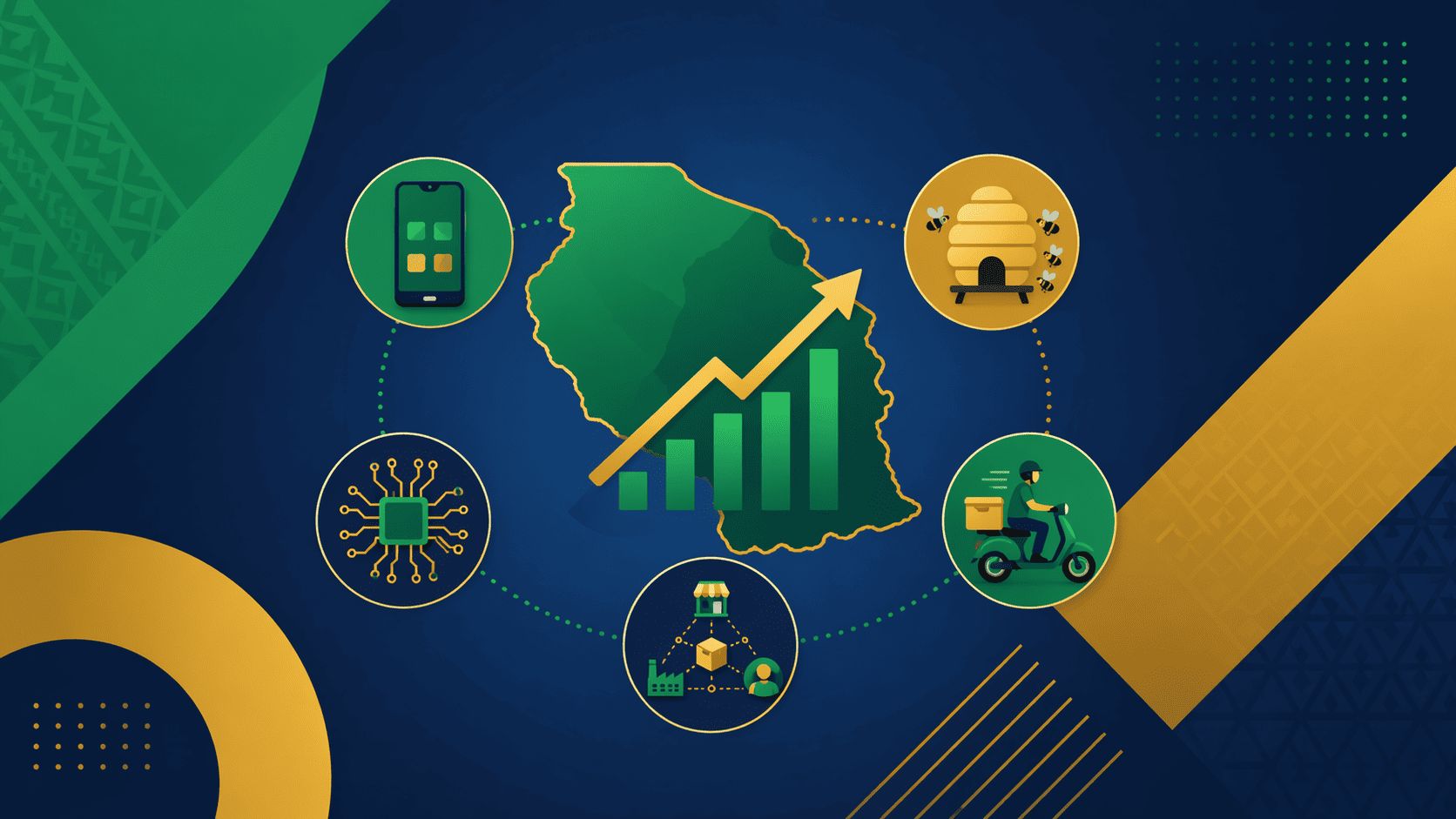
Tanzania is no longer just a bystander in East Africa's tech story. It is quickly becoming one of the region's most exciting startup destinations — and the numbers prove it.
According to the Tanzania Startup Association's 2024 Ecosystem Report, the number of active startups rose by 24%, reaching over 1,041 ventures. Foreign Direct Investment into the sector more than doubled, hitting $53 million — a 112% increase — while domestic investment grew by 85.5%. FinTech alone attracted $41.4 million, accounting for nearly 80% of all foreign capital flowing into startups. Over 138,000 jobs have been created — a 23% rise from the previous year.
The ecosystem has produced globally significant exits and milestones: Y Combinator-backed fintechs are raising tens of millions, supply chain startups are digitizing trillion-dollar industries, healthcare innovators are reimagining medicine delivery, and agribusinesses are shipping Tanzanian products to Japan, Europe, and North America.
From the streets of Dar es Salaam to the honey farms of Dodoma, here are ten Tanzanian startups you should be watching right now.
1. NALA — Rewriting the Rules of African Payments
Sector: FinTech | Stage: Series A

If there is one Tanzanian startup that has captured global attention, it is NALA. Founded in 2017 by Benjamin Fernandes — a former national television host — NALA began as a domestic payment app in Tanzania before pivoting in 2021 to tackle cross-border remittances.
The pivot paid off spectacularly. In July 2024, NALA raised a $40 million Series A — one of the largest Series A rounds in African tech history — led by Acrew Capital, with participation from DST Global, Norrsken22, HOF Capital, and angel investors including Robinhood's Vlad Tenev and Chime's Ryan King. The round came just two years after a $10 million seed raise in 2022.
Today, NALA's consumer app lets users in the EU, UK, and US send money to 249 banks and 26 mobile money services across 11 African markets, including Kenya, Uganda, Rwanda, Nigeria, and Tanzania. The startup achieved a 10x increase in revenue in a single year, reached profitability, and recorded a 34x surge in transaction volume over 20 months.
But NALA's most ambitious move is Rafiki — a B2B payments platform that lets global businesses and fintechs make payments directly into African bank accounts and mobile money wallets. Early clients include UK-based TransferGo and global payroll firm Cadana. By 2025, NALA had facilitated over $1 billion in cross-border flows — a milestone that cements it as serious infrastructure, not just a consumer app.
NALA became the first East African company to enter Y Combinator in 2019 — after five failed attempts. That grit has defined the company ever since.
Why it matters for East Africa: For the millions of Tanzanians, Kenyans, and Ugandans in the diaspora, NALA is making it cheaper and faster to send money home. For businesses, Rafiki is building the payment rails that East Africa's digital economy needs to scale.
2. Ramani — Fixing Africa's Broken Supply Chains
Sector: Supply Chain / FinTech | Stage: Series A

Walk into any duka (small shop) in Dar es Salaam and ask where they source their Coca-Cola or Harpic — chances are, it came through a micro-distribution centre (MDC). These informal distributors are the invisible backbone of East Africa's consumer goods economy. Ramani is the startup digitizing them.
Founded in 2019 in a family house by brothers Iain and Calvin Usiri and Kibet Martin — Stanford and Google alumni — Ramani raised $32 million in a Series A round led by Flexcap Ventures. Like NALA, it is a Y Combinator (W20) graduate, making it one of only two Tanzanian startups to have gone through the prestigious Silicon Valley accelerator.
Ramani provides MDCs with inventory management software, procurement tools, and point-of-sale systems — all for free. It monetizes by offering supply chain financing to those same distributors, using the transaction data it collects to underwrite credit. After receiving its lending license from the Bank of Tanzania, the startup rolled out a 30-day inventory financing product and a 14-day revolving credit line for qualified distributors.
The results are striking. MDCs on Ramani's platform have grown their revenues by at least 20%, and the startup has facilitated over $210 million in cumulative loans with 136% month-on-month growth in disbursements. Its marketplace has expanded to partner with Stanbic Bank and Tanzania Commercial Bank, now serving brands including Coca-Cola, Diageo, and ABInBev.
Why it matters for East Africa: Africa's consumer goods supply chain is worth $1 trillion — yet most of it runs on WhatsApp messages and paper receipts. Ramani is building the digital infrastructure to unlock that value, starting in Tanzania and eyeing the rest of the continent.
3. Tembo Plus — The FinTech Infrastructure Layer
Sector: FinTech Infrastructure | Stage: Early Growth

While NALA serves consumers and Ramani serves distributors, Tembo Plus is building the invisible financial plumbing that powers businesses across Africa. Founded by Victor Joseph and Reuben Mwatosya, Tembo Plus is a Dar es Salaam-born API and SDK platform that lets businesses embed financial services — payments, card issuance, virtual accounts, savings, and programmable bank accounts — directly into their products.
Think of it as the Stripe or Plaid of East Africa, but built specifically for the realities of the African market.
In a landmark milestone, Tembo Plus received its Payment Service Provider (PSP) license from the Bank of Tanzania, a critical regulatory step that allows it to operate independently, process domestic and cross-border payments, and offer merchant services. It works with established financial institutions including Ecobank, Flutterwave, Cellulant, and AzamPay to process transactions, and holds regulatory approvals in Tanzania, Rwanda, and Kenya.
Following DeveloPPP Ventures program funding, Tembo Plus achieved 10 times transaction growth — a number that signals the real demand for its infrastructure-as-a-service model. According to Rive & Co's fintech legal analysis, Tembo Plus is among the standout startups poised to benefit from Tanzania's Bank of Tanzania Fintech Regulatory Sandbox (2025), which allows companies to test products in a controlled environment before full market launch.
Why it matters for East Africa: Africa's fintech ecosystem needs shared infrastructure. Rather than every startup building payment rails from scratch, platforms like Tembo Plus allow developers and businesses to launch financial products in weeks — democratizing access to finance across the region.
4. Swahilies — The SME Financial OS
Sector: FinTech / SME SaaS | Stage: Early Growth

Tanzania has over two million micro, small, and medium enterprises. Most of them still manage their inventory on paper, collect payments in cash, and have no formal credit history. Swahilies is changing that.
Founded in 2021 and led by CEO John Haule, Swahilies launched as an e-commerce installment platform before pivoting in late 2022 to become a full SME management and financial services ecosystem. The platform runs two core products: Kuza Business, which handles digital bookkeeping and inventory management, and Swahilies Pay, which processes mobile money and card payments. Together, they give small business owners the tools to digitize their operations, build verifiable credit scores, and access financing.
As Haule himself writes in Fintech News Africa, the platform now serves over 10,000 SMEs in Tanzania, 10% of whom are paying users. Swahilies received €100,000 from the DeveloPPP Ventures program in 2025 — and in December 2024, it partnered with SPENN to expand into Zambia, marking its first move beyond Tanzania's borders. The startup is now piloting cross-border payment capabilities, helping Tanzanian SMEs pay international suppliers — a pain point created by dollar scarcity. The Guardian Tanzania highlights Swahilies as one of the standout digital management tools for businesses recognised at national fintech forums.
Why it matters for East Africa: In a region where most SMEs are invisible to formal lenders because they lack financial records, Swahilies creates a digital paper trail that opens the door to credit. That is not just a business opportunity — it is a structural shift in how the informal economy gets financed.
5. Piki Tanzania — Profitable Food Delivery in Africa's Toughest Market
Sector: On-Demand Delivery / E-Commerce | Stage: Profitable & Growing

In a global market where food delivery companies routinely burn cash for years to stay alive, Piki Tanzania has done something remarkable: it turned a profit. That too, having raised only $600,000 to $800,000 in total capital since its founding in 2019.
Founded by CEO Zadok Prescott and COO Emmanuel Challe — two alumni of Jumia, Africa's largest e-commerce platform — Piki operates across five Tanzanian cities including Dar es Salaam and Arusha. It processes an average of 1,300 orders daily, connects customers to restaurants, grocery stores, and general merchandise, and typically delivers within 40 minutes. The company is estimated to be valued at $8–12 million, according to Atoms & Bits.
Piki's secret? Extreme capital discipline and obsessive focus on execution. While over 15 competitors have shut down in the same period, Piki survived by refusing to overspend. No giant offices, no untargeted billboards. As Challe explains, the hardest competitor isn't another app — it's the mama mboga, the neighbourhood vendor who delivers faster, cheaper, with a personal relationship. Piki's advantage is variety: the ability to order anything from across the city in one tap.
Why it matters for East Africa: Tanzania's online food delivery market is projected to reach $462 million by 2024 and $826 million by 2029, growing at over 12% annually. Piki shows that East African startups can build sustainable, profitable businesses without chasing venture capital at all costs.
6. Silabu — Making Every African Student a Global Learner
Sector: EdTech | Stage: Early Growth

Tanzania has a teacher-to-student ratio of 1:50 in many schools. Quality tutoring has historically been a privilege only for urban, wealthier families. Silabu is on a mission to change that through technology.
Founded in 2019 as SmartClass at the University of Dar es Salaam and rebranded to Silabu in 2022, the platform enables students to book one-on-one tutors on demand in 40 seconds, join peer-to-peer study groups for free, and attend live group classes taught by top tutors — at a cost up to 10 times cheaper than traditional private tutoring fees. The platform also supports an audio-only mode, ensuring students with poor internet connections in rural Tanzania can still attend live classes.
Silabu became the first Tanzanian edtech startup selected for Google for Startups Accelerator Africa in 2022, a validation that put it on the continental map. It has since been backed by iHub, Google for Startups, and Acumen Fund. In 2024, Silabu was named an African finalist at the Global EdTech Startup Awards (GESAwards) semifinals in London — the company had by then recorded 14.6 million learning minutes across Africa in 2022. The platform has since expanded to Kenya, and has partnered with Vodacom Tanzania, which offers subsidised "Silabu Bundles" so that more students can afford to access it.
Through the DeveloPPP Ventures program, Silabu now offers on-demand tutors nationwide, having significantly expanded its geographical reach.
Why it matters for East Africa: Africa has 700 million young people. As internet penetration grows across East Africa, platforms like Silabu can bridge the quality gap in education without requiring expensive private schools or physical infrastructure.
7. Swahili Honey — Taking Tanzanian Honey to the World
Sector: AgriTech / Agribusiness | Stage: Revenue-Generating Scale-Up

Not all great startups are tech platforms. Sometimes the most powerful innovation is simply connecting what Africa has in abundance to markets that need it. That is what Swahili Honey does with bees.
Founded by brothers Joseph and Christopher Kadendula out of a small workshop in Dodoma, Swahili Honey (under parent company Central Park Bees) has built a network of over 2,500 smallholder beekeepers across Njombe, Tabora, Kigoma, and Kahama. The company provides farmers with modern beehives, training, and a guaranteed market — eliminating the middlemen who historically captured most of the value.
The financial trajectory is impressive: revenue grew from $469,000 in 2019 to $2.7 million in 2023 — a 475% increase in just four years. Backed by Africa Eats and with support from Japan's JICA (Japan International Cooperation Agency), Swahili Honey achieved organic certification and in a landmark milestone exported its first 20-ton shipment of organic honey to Japan. Products now ship to Africa, the Middle East, Europe, North America, and Asia. A traceability system links each honey batch back to the specific farmer and hive it came from.
Tanzania has the potential to produce up to 138,000 tons of honey annually — yet only 22% of that potential is currently being tapped. Swahili Honey is proof of what is possible when that gap is closed.
Why it matters for East Africa: Millions of smallholder farmers across the region live in poverty not because they lack resources, but because they lack market access and fair pricing. Swahili Honey's model — aggregation, certification, and export — is a blueprint replicable across coffee, spices, sesame, and more.
8. Dawa Mkononi — Medicine at the Palm of Your Hand
Sector: HealthTech / Pharmaceutical Logistics | Stage: Seed

Dr. Joseph Paul Manda, founder of Dawa Mkononi, became an entrepreneur out of heartbreak. While assisting at a rural birth in Tanzania, he found that the essential drug to accelerate labour was unavailable. Six hours later, the family returned with a medicine that proved ineffective — likely a counterfeit. That moment sparked a mission.
Dawa Mkononi — Swahili for "Medicine at your Palms" — is a B2B pharmaceutical supply chain platform that allows pharmacies, clinics, and hospitals to order authentic medicines via a mobile app, pay through integrated fintech options (including Selcom Pay), and receive timely deliveries backed by real-time inventory data. The platform combines AI-powered credit scoring, inventory tracking, and logistics optimization into a single digital ecosystem — addressing the three biggest pain points in Tanzania's pharmaceutical supply chain: stockouts, price instability, and counterfeit drugs.
Founded in 2022, Dawa Mkononi has attracted a constellation of investors: the Sanofi Global Health Unit Impact Fund, Pontem Ventures, Warioba Ventures, Villgro Africa, and Axian Group. In 2024, it was selected as the inaugural recipient of SEAF's Daraja Impact funding. Today, the platform serves 3,000+ healthcare facilities, with over 25% of orders financed through its embedded lending model. DeveloPPP funding in 2025 enabled it to expand medicine delivery to Zanzibar, while its Q1 2025 revenue report showed $105,202 in sales — 86% higher than 2024's quarterly average.
Why it matters for East Africa: Drug stockouts kill. In a region where supply chain inefficiencies routinely leave pharmacies empty and patients underserved, Dawa Mkononi's model of digital procurement, real-time logistics, and embedded credit is a direct answer to a life-or-death problem.
9. Medikea — Affordable Healthcare for the 85%
Sector: HealthTech / Telemedicine | Stage: Seed

In Tanzania, patients in public hospitals often wait up to five hours for basic care. Private hospitals cost two to three times more than the average Tanzanian can afford. And 85% of Tanzanians lack access to the essential care they need. Enter Medikea.
Founded in 2023 by Dr. Elvis Silayo (CEO) and Dr. Desire Ruhinda (COO) — both veterans of Tanzania's national hospital system — Medikea operates a hybrid model that combines 24/7 telemedicine with strategically located, cost-effective physical clinics in underserved communities. The clinics offer diagnostics, consultations, specialist referrals, and pharmacy services at nearly half the cost of alternative private options. Their first clinic broke even within 12 months — a rare achievement in the healthcare startup world.
Medikea has attracted backing from both the Catalyst Fund and pan-African VC program Madica, which poured approximately $800,000 into four startups across Africa in its February 2025 round, including Medikea. The startup also received $50,000 from The Baobab Network accelerator and is the first telemedicine provider in Tanzania to secure insurance partnerships with Jubilee Insurance, Assemble Insurance, and GA Insurance. In just over a year of operations, Medikea delivered care to nearly 10,000 Tanzanians. With fresh investment in hand, it now plans to expand to five new locations and serve over 200,000 patients.
Why it matters for East Africa: East Africa faces a dual crisis — chronic underfunding of public health systems combined with rapidly worsening climate-related health challenges. Medikea's model, which is not just tech-forward but also physically embedded in communities, offers a scalable blueprint for bridging that gap.
10. Tri Electric — Clean Wheels for African Cities
Sector: Clean Tech / Electric Mobility | Stage: Early Revenue

East Africa's cities are choking. The bajajs (auto-rickshaws) and boda-bodas that transport millions every day run on petrol engines that emit high levels of pollution, cost riders more over time, and are increasingly expensive for operators to maintain. Tri Electric is building the cleaner alternative.
The Tanzanian startup produces electric bajajs designed for urban mobility, replacing polluting conventional vehicles with locally manufactured EVs. Tri Electric has crossed $1 million in revenue, with its founder publicly committing to sustained profitability — a rare and credible signal in a sector that often over-promises. As Reuben Mars reports, Trio Electric is demonstrating that clean mobility can be financially viable in a real African market, with real customers, real roads, and real constraints.
These ventures are part of a broader East African electric mobility wave — Kenya's Roam and Uganda's Zembo have shown the model is viable; Trio Electric is proving it for Tanzania.
Why it matters for East Africa: Urban transport is one of the biggest sources of air pollution and household expense across East African cities. Electric vehicles, manufactured locally and priced for local incomes, could transform daily life — while contributing to the region's climate commitments.
The Bigger Picture: Tanzania's Startup Ecosystem in 2026
Tanzania's startup story is not without challenges. As reported by The Citizen, 2025 proved a difficult fundraising year — Tanzanian startups raised less than $15 million by mid-year, a steep drop from the $53 million raised in 2024. The Tanzania Startup Association (TSA) has attributed this to delays in the Startup Policy, the Sh100 billion Tanzania Venture Capital Fund, and regulatory changes needed to allow VC firms to incorporate locally.
But the fundamentals remain strong:
- 53 million mobile money users — up 19.6% year-on-year
- 36.8 million internet subscribers, growing 10% annually per the World Bank
- A government targeting 6% GDP growth with AI labs and 1,374+ new communication towers
- The launch of TISEZA — Tanzania's single-window investment authority — simplifying the path for foreign investors
- A Bank of Tanzania Fintech Regulatory Sandbox that opened in January 2025, giving innovative fintechs a safe space to test ideas before full launch
- Tanzania ranked 3rd in startup fundraising across Africa in Q1–Q3 2024, with 66.5 million mobile money subscriptions driving digital adoption
The African Development Bank projects Tanzania's tech sector could hit $1 billion if fintech adoption reaches 50% of SMEs. The East African Community Secretariat estimates $200 million in digital services exports by 2027 under AfCFTA.
Tanzania has already given the world KopaGas (acquired for $25M — the largest clean cooking tech deal in Africa's history), NALA, and Ramani. The next decade promises far more.
Final Thoughts
Tanzania is building something real. Not just startups chasing valuations, but businesses solving the actual problems that people in East Africa live with every single day — remittances that are too expensive, supply chains that are too opaque, medicines that never arrive, healthcare that is out of reach, and students who learn alone because they can't afford a tutor.
For East African founders, investors, and professionals, the message is clear: watch Tanzania closely. The ecosystem is young, the problems are massive, and the founders building solutions here have the grit, local knowledge, and — increasingly — the capital to go the distance.
Sources: TechCrunch | TechPoint Africa | Disrupt Africa | The Citizen Tanzania | How We Made It in Africa | IPP Media / The Guardian Tanzania | Fintech News Africa | Atoms & Bits | Madica VC | SEAF | Catalyst Fund | Tanzania Startup Association